
 English
 Español
 Français
 Italiano
 Nederlands
 Polski
' d='M48 28h24v18a12 12 0 0 1-24 0z'/%3E%3Cpath fill='%230093DD' d='M47.5 21.5h4.6V28h-4.6zm10.2-2.5h4.6v9h-4.6zm10.2 2.5h4.6V28h-4.6z'/%3E%3Cpath fill='%23171796' d='M52.6 20h4.6v8h-4.6zm10.2 0h4.6v8h-4.6z'/%3E%3C/svg%3E) Hrvatski
 עברית
Für Apps
Gruppen-Videoanrufe für Ihre App
Eine Videokonferenz-API und ein SDK für Next.js, Laravel, Django und jeden anderen Stack. Meetings, Kurse, Podien und Audioräume laufen auf unseren Medienservern, ohne Grenze bei den Personen im Anruf, und der Anrufbildschirm ist sofort nutzbar, sodass Sie keinen Medienserver betreiben müssen.
Die besten Preise für WebSockets, unbegrenzte 1:1-Anrufe mit TURN-Servern weltweit sowie Gruppenanrufe und Live-Streaming mit inklusivem Kontingent. Ab $11.99 im Monat für 1.000 gleichzeitige Verbindungen, jährlich abgerechnet, oder $14.99 bei monatlicher Abrechnung.
Gruppenanrufe über Ihren Plan hinaus: $0.20 pro 1.000 Minuten, $0.10 per Audio.
Next.js auf dem Server und React auf der Seite.
export async function GET( request: Request ) {
    const me = await currentUserId();
    const id = new URL( request.url ).searchParams.get( 'id' )!;

    // Your own check: only its team, and its lead is the host.
    if ( ! me || ! await isMemberOf( id, me ) ) {
        return new Response( null, { status: 403 } );
    }

    const token = await realtime.groupCallToken( me, 'meeting:' + id, {
        admin: await isLeadOf( id, me ),
    } );

    return Response.json( { token } );
}app.get( '/api/meeting-token', async ( req, res ) => {
const me = userOf( req );
const { id } = req.query;
// Your own check: only its team, and its lead is the host.
if ( ! me || ! await isMemberOf( id, me ) ) {
return res.sendStatus( 403 );
}
const token = await realtime.groupCallToken( me, 'meeting:' + id, {
admin: await isLeadOf( id, me ),
} );
res.json( { token } );
} );import { createServer } from 'node:http';
createServer( async ( req, res ) => {
const url = new URL( req.url, 'http://localhost' );
if ( url.pathname === '/api/meeting-token' ) {
const me = userOf( req );
const id = url.searchParams.get( 'id' );
// Your own check: only its team, and its lead is the host.
if ( ! me || ! await isMemberOf( id, me ) ) {
res.writeHead( 403 );
return res.end();
}
const token = await realtime.groupCallToken( me, 'meeting:' + id, {
admin: await isLeadOf( id, me ),
} );
res.writeHead( 200, { 'Content-Type': 'application/json' } );
return res.end( JSON.stringify( { token } ) );
}
// Your pages, and realtime.node( userOf ) for the SDK's routes.
} ).listen( 3000 );use Illuminate\Http\Request;
use WordPlus\Realtime\Laravel\Facades\Realtime;
Route::get( '/api/meeting-token', function ( Request $request ) {
$me = $request->user()->id;
$id = $request->query( 'id' );
// Your own check: only its team, and its lead is the host.
abort_unless( is_member_of( $id, $me ), 403 );
return [ 'token' => Realtime::groupCallToken( $me, 'meeting:' . $id, [
'admin' => is_lead_of( $id, $me ),
] ) ];
} )->middleware( 'auth' );require __DIR__ . '/../src/realtime.php';
$me = current_user_id();
$id = $_GET['id'] ?? '';
// Your own check: only its team, and its lead is the host.
if ( ! $me || ! is_member_of( $id, $me ) ) {
http_response_code( 403 );
exit;
}
header( 'Content-Type: application/json' );
echo json_encode( [
'token' => $realtime->groupCallToken( $me, 'meeting:' . $id, [
'admin' => is_lead_of( $id, $me ),
] ),
] );from django.contrib.auth.decorators import login_required
from django.http import HttpResponseForbidden, JsonResponse
from .realtime import realtime
# In urls.py: path("api/meeting-token", views.meeting_token)
@login_required
def meeting_token(request):
me = request.user.id
id = request.GET["id"]
# Your own check: only its team, and its lead is the host.
if not is_member_of(id, me):
return HttpResponseForbidden()
token = realtime.group_call_token(
me, "meeting:" + id, admin=is_lead_of(id, me)
)
return JsonResponse({"token": token})from fastapi import Depends, HTTPException
from realtime import realtime
@app.get("/api/meeting-token")
def meeting_token(id: str, me: int = Depends(current_user_id)):
# Your own check: only its team, and its lead is the host.
if not me or not is_member_of(id, me):
raise HTTPException(403)
token = realtime.group_call_token(
me, "meeting:" + id, admin=is_lead_of(id, me)
)
return {"token": token}from flask import abort, request, session
from realtime import realtime
@app.get("/api/meeting-token")
def meeting_token():
me = session.get("user_id")
id = request.args["id"]
# Your own check: only its team, and its lead is the host.
if not me or not is_member_of(id, me):
abort(403)
token = realtime.group_call_token(
me, "meeting:" + id, admin=is_lead_of(id, me)
)
return {"token": token}// http.HandleFunc("GET /api/meeting-token", meetingToken)
func meetingToken(w http.ResponseWriter, r *http.Request) {
me := userOf(r)
id := r.URL.Query().Get("id")
// Your own check: only its team, and its lead is the host.
if me == "" || !isMemberOf(id, me) {
w.WriteHeader(403)
return
}
token := app.GroupCallToken(me, "meeting:"+id, wordplus.GroupPlace{
Admin: isLeadOf(id, me),
Info: profile(me),
})
reply(w, map[string]string{"token": token})
}Hooks und Komponenten für jede React-App, auf jedem der Server oben.
import { connect } from '@wordplus/realtime';

const rt = await connect();

// The call window.
await rt.callScreen();

// And in the page:
// <group-call-button call="meeting:7"
//     token-url="/api/meeting-token?id=7"
//     type="video" title="Daily meeting">
//     Join the meeting
// </group-call-button>import { connect } from '@wordplus/realtime';
const rt = await connect();
// The call window.
await rt.callScreen();
// And in the page:
// <group-call-button call="meeting:7"
// token-url="/api/meeting-token?id=7"
// type="video" title="Daily meeting">
// Join the meeting
// </group-call-button>import { connect } from '@wordplus/realtime';
const rt = await connect();
// The call window.
await rt.callScreen();
// And in the page:
// <group-call-button call="meeting:7"
// token-url="/api/meeting-token?id=7"
// type="video" title="Daily meeting">
// Join the meeting
// </group-call-button>import { connect } from '@wordplus/realtime';
const rt = await connect();
// The call window.
await rt.callScreen();
// And in the page:
// <group-call-button call="meeting:7"
// token-url="/api/meeting-token?id=7"
// type="video" title="Daily meeting">
// Join the meeting
// </group-call-button>import { connect } from '@wordplus/realtime';
const rt = await connect();
// The call window.
await rt.callScreen();
// And in the page:
// <group-call-button call="meeting:7"
// token-url="/api/meeting-token?id=7"
// type="video" title="Daily meeting">
// Join the meeting
// </group-call-button>import { connect } from '@wordplus/realtime';
const rt = await connect();
// The call window.
await rt.callScreen();
// And in the page:
// <group-call-button call="meeting:7"
// token-url="/api/meeting-token?id=7"
// type="video" title="Daily meeting">
// Join the meeting
// </group-call-button>import { connect } from '@wordplus/realtime';
const rt = await connect();
// The call window.
await rt.callScreen();
// And in the page:
// <group-call-button call="meeting:7"
// token-url="/api/meeting-token?id=7"
// type="video" title="Daily meeting">
// Join the meeting
// </group-call-button>import { connect } from '@wordplus/realtime';
const rt = await connect();
// The call window.
await rt.callScreen();
// And in the page:
// <group-call-button call="meeting:7"
// token-url="/api/meeting-token?id=7"
// type="video" title="Daily meeting">
// Join the meeting
// </group-call-button>import { connect } from '@wordplus/realtime';
const rt = await connect();
// The call window.
await rt.callScreen();
// And in the page:
// <group-call-button call="meeting:7"
// token-url="/api/meeting-token?id=7"
// type="video" title="Daily meeting">
// Join the meeting
// </group-call-button><group-call-button call="meeting:7" token-url="/api/meeting-token?id=7" type="video" title="Daily meeting">
Join the meeting
</group-call-button>
<script type="module">
// The call window, on every page a meeting may open from.
await window.Echo.connector.rt.callScreen();
</script>'use client'; // in Next.js
import { CallScreen, GroupCallButton } from '@wordplus/realtime/react';
// Inside <RealtimeProvider>, once for the whole app.
export function JoinMeeting() {
return (
<>
<CallScreen />
<GroupCallButton call="meeting:7" tokenUrl="/api/meeting-token?id=7" type="video" title="Daily meeting">
Join the meeting
</GroupCallButton>
</>
);
}<script setup>
import { watchEffect } from 'vue';
import { useRealtime } from '@wordplus/realtime/vue';
// provideRealtime() once, in your root component.
const rt = useRealtime();
// The call window, on every page a meeting may open from.
watchEffect( () => rt.value?.callScreen() );
</script>
<!-- isCustomElement for this tag, in vite.config.js -->
<template>
<group-call-button call="meeting:7" token-url="/api/meeting-token?id=7" type="video" title="Daily meeting">
Join the meeting
</group-call-button>
</template><script>
import { useRealtime } from '@wordplus/realtime/svelte';
// provideRealtime() once, in your root component.
const rt = useRealtime();
// The call window, on every page a meeting may open from.
$effect( () => { rt.current?.callScreen(); } );
</script>
<group-call-button call="meeting:7" token-url="/api/meeting-token?id=7" type="video" title="Daily meeting">
Join the meeting
</group-call-button>import { Component, CUSTOM_ELEMENTS_SCHEMA } from '@angular/core';
// realtime.ts, one connection for the whole app:
// export const realtime = connect();
import { realtime } from './realtime';
@Component( {
selector: 'app-join-meeting',
schemas: [ CUSTOM_ELEMENTS_SCHEMA ],
template: `<group-call-button call="meeting:7" token-url="/api/meeting-token?id=7" type="video" title="Daily meeting">Join the meeting</group-call-button>`,
} )
export class JoinMeetingComponent {
async ngOnInit() {
const rt = await realtime;
// The call window, on every page a meeting may open from.
await rt.callScreen();
}
}import WordPlusRealtimeCalls
import WordPlusRealtimeUI
let token = try await api.meetingToken(id: 7) // your own request to your route
let meeting = try await rt.joinGroupCall(token)
CallScreen.shared.show(meeting, title: "Daily meeting")import cloud.wordplus.realtime.calls.joinGroupCall
import cloud.wordplus.realtime.ui.CallScreen
val token = api.meetingToken(id = 7) // your own request to your route
val meeting = rt.joinGroupCall(context, token)
CallScreen.show(context, meeting, title = "Daily meeting")import {
CallScreen, GroupCallButton, RealtimeProvider,
} from '@wordplus/realtime-react-native';
// Your server, in full, as an app has no address of its own.
const API = 'https://app.example.com/api';
const options = {
app: 's1500000007',
endpoint: API + '/realtime',
headers: { Authorization: 'Bearer ' + session.token },
};
export function App() {
return (
<RealtimeProvider options={ options }>
<CallScreen />
<GroupCallButton call="meeting:7" type="video" title="Daily meeting"
tokenUrl={ API + '/meeting-token?id=7' }>
Join the meeting
</GroupCallButton>
</RealtimeProvider>
);
}import 'package:flutter/material.dart';
import 'package:wordplus_realtime/wordplus_realtime.dart';
// Your server, in full, as an app has no address of its own.
const api = 'https://app.example.com/api';
// Once, as your app starts.
final rt = await WordPlusRealtime.connect(
app: 's1500000007',
endpoint: '$api/realtime',
headers: {'Authorization': 'Bearer ${session.token}'},
);
// The call window.
await rt.callScreen();
// In your build:
GroupCallButton(
rt: rt,
call: 'meeting:7',
tokenUrl: '$api/meeting-token?id=7',
title: 'Daily meeting',
child: const Text('Join the meeting'),
)Gruppenanruf ausprobieren
Starten Sie hier einen Raum und holen Sie bis zu drei weitere Personen über ihre Smartphones oder andere Fenster dazu. Kein Konto nötig.
Das sind die Bildschirme, die das SDK Ihrer App gibt. Ihr Browser fragt nach Kamera und Mikrofon, nichts wird aufgezeichnet, und die Demo endet nach 10 Minuten.
Gruppenanrufe
Gruppenanrufe auf unseren Medienservern
Meetings, Kurse, Podien und Audioräume laufen auf unseren Medienservern, nicht zwischen den Geräten, sodass jedes Gerät seine Kamera nur einmal sendet, wie viele Personen auch im Anruf sind.
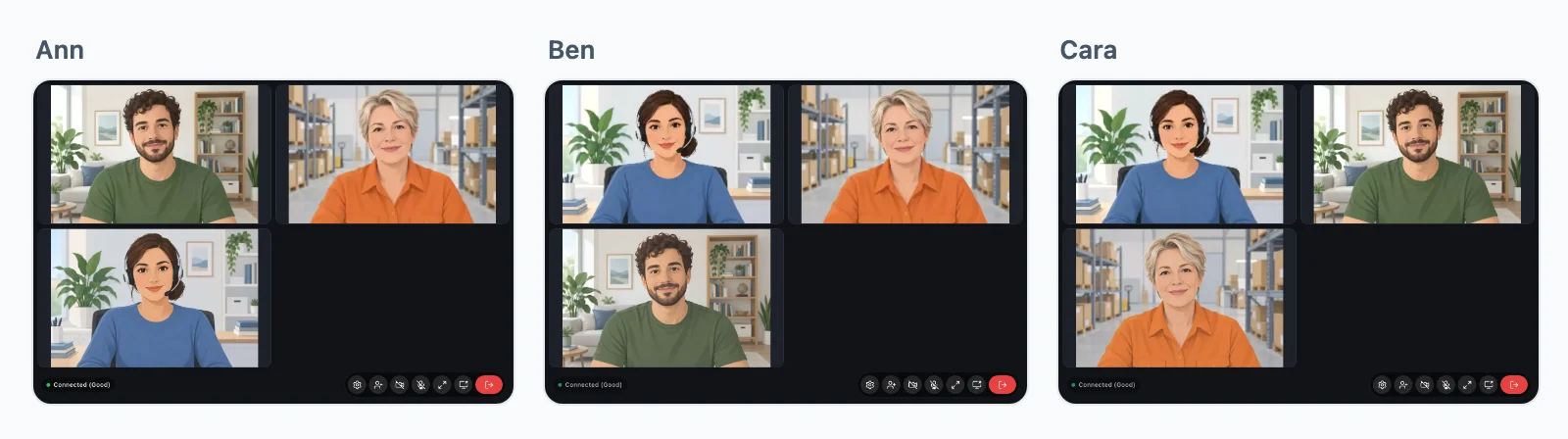
Keine Grenze bei den Personen
Jede Person in einem Gruppenanruf sendet Kamera, Mikrofon und Bildschirm einmal, und unsere Medienserver geben sie an alle anderen weiter, in mehreren Regionen.
Sprecher und Zuhörer
Ihr Server legt fest, wer sendet und wer nur zusieht und zuhört, wie in einem Kurs oder auf einem Podium. Ein Host lässt einen Zuhörer sprechen und macht ihn wieder zum Zuhörer.
Hosts sorgen für Ordnung
Ein Host schaltet ein Mikrofon stumm, lässt jemanden sprechen und entfernt jemanden aus dem Anruf, über die Kachel jeder Person.
Ihr Server entscheidet
Ein Meeting durchführen, vom Anfang bis zum Ende
Ihr Server legt fest, wer beitritt und wer Host ist, und die Seite oder Ihr Server erledigt den Rest. Hier sehen Sie ein Team-Meeting und dann einen Kurs, Aufgabe für Aufgabe.
Next.js auf dem Server und React auf der Seite.
Der Seite ein Token geben
Ein Gruppenanruf ist nur ein Name, etwa meeting:7, in der Cloud muss nichts angelegt werden. Wer beitritt und wer Host ist, gehört zur eigenen Logik Ihrer App und liegt daher in einer eigenen Route, die mit einem Token antwortet. isMemberOf und isLeadOf sind Ihre eigenen Abfragen.
export async function GET( request: Request ) {
    const me = await currentUserId();
    const id = new URL( request.url ).searchParams.get( 'id' )!;

    // Your own check: only its team, and its lead is the host.
    if ( ! me || ! await isMemberOf( id, me ) ) {
        return new Response( null, { status: 403 } );
    }

    const token = await realtime.groupCallToken( me, 'meeting:' + id, {
        admin: await isLeadOf( id, me ),
    } );

    return Response.json( { token } );
}app.get( '/api/meeting-token', async ( req, res ) => {
const me = userOf( req );
const { id } = req.query;
// Your own check: only its team, and its lead is the host.
if ( ! me || ! await isMemberOf( id, me ) ) {
return res.sendStatus( 403 );
}
const token = await realtime.groupCallToken( me, 'meeting:' + id, {
admin: await isLeadOf( id, me ),
} );
res.json( { token } );
} );import { createServer } from 'node:http';
createServer( async ( req, res ) => {
const url = new URL( req.url, 'http://localhost' );
if ( url.pathname === '/api/meeting-token' ) {
const me = userOf( req );
const id = url.searchParams.get( 'id' );
// Your own check: only its team, and its lead is the host.
if ( ! me || ! await isMemberOf( id, me ) ) {
res.writeHead( 403 );
return res.end();
}
const token = await realtime.groupCallToken( me, 'meeting:' + id, {
admin: await isLeadOf( id, me ),
} );
res.writeHead( 200, { 'Content-Type': 'application/json' } );
return res.end( JSON.stringify( { token } ) );
}
// Your pages, and realtime.node( userOf ) for the SDK's routes.
} ).listen( 3000 );use Illuminate\Http\Request;
use WordPlus\Realtime\Laravel\Facades\Realtime;
Route::get( '/api/meeting-token', function ( Request $request ) {
$me = $request->user()->id;
$id = $request->query( 'id' );
// Your own check: only its team, and its lead is the host.
abort_unless( is_member_of( $id, $me ), 403 );
return [ 'token' => Realtime::groupCallToken( $me, 'meeting:' . $id, [
'admin' => is_lead_of( $id, $me ),
] ) ];
} )->middleware( 'auth' );require __DIR__ . '/../src/realtime.php';
$me = current_user_id();
$id = $_GET['id'] ?? '';
// Your own check: only its team, and its lead is the host.
if ( ! $me || ! is_member_of( $id, $me ) ) {
http_response_code( 403 );
exit;
}
header( 'Content-Type: application/json' );
echo json_encode( [
'token' => $realtime->groupCallToken( $me, 'meeting:' . $id, [
'admin' => is_lead_of( $id, $me ),
] ),
] );from django.contrib.auth.decorators import login_required
from django.http import HttpResponseForbidden, JsonResponse
from .realtime import realtime
# In urls.py: path("api/meeting-token", views.meeting_token)
@login_required
def meeting_token(request):
me = request.user.id
id = request.GET["id"]
# Your own check: only its team, and its lead is the host.
if not is_member_of(id, me):
return HttpResponseForbidden()
token = realtime.group_call_token(
me, "meeting:" + id, admin=is_lead_of(id, me)
)
return JsonResponse({"token": token})from fastapi import Depends, HTTPException
from realtime import realtime
@app.get("/api/meeting-token")
def meeting_token(id: str, me: int = Depends(current_user_id)):
# Your own check: only its team, and its lead is the host.
if not me or not is_member_of(id, me):
raise HTTPException(403)
token = realtime.group_call_token(
me, "meeting:" + id, admin=is_lead_of(id, me)
)
return {"token": token}from flask import abort, request, session
from realtime import realtime
@app.get("/api/meeting-token")
def meeting_token():
me = session.get("user_id")
id = request.args["id"]
# Your own check: only its team, and its lead is the host.
if not me or not is_member_of(id, me):
abort(403)
token = realtime.group_call_token(
me, "meeting:" + id, admin=is_lead_of(id, me)
)
return {"token": token}// http.HandleFunc("GET /api/meeting-token", meetingToken)
func meetingToken(w http.ResponseWriter, r *http.Request) {
me := userOf(r)
id := r.URL.Query().Get("id")
// Your own check: only its team, and its lead is the host.
if me == "" || !isMemberOf(id, me) {
w.WriteHeader(403)
return
}
token := app.GroupCallToken(me, "meeting:"+id, wordplus.GroupPlace{
Admin: isLeadOf(id, me),
Info: profile(me),
})
reply(w, map[string]string{"token": token})
}Einen Beitrittsknopf hinzufügen
Der fertige Bildschirm: ein Knopf und ein Anruffenster mit jeder Kachel und jedem Bedienelement, ganz ohne Anrufcode. Der Knopf fragt Ihre Route nach seinem Token.
Hooks und Komponenten für jede React-App, auf jedem der Server oben.
import { connect } from '@wordplus/realtime';

const rt = await connect();

// The call window, on every page a meeting may open from.
await rt.callScreen();

// And in the page. The button asks your route for its token.
// <group-call-button call="meeting:7" token-url="/api/meeting-token?id=7" type="video" title="Daily meeting">
//     Join the meeting
// </group-call-button>import { connect } from '@wordplus/realtime';
const rt = await connect();
// The call window, on every page a meeting may open from.
await rt.callScreen();
// And in the page. The button asks your route for its token.
// <group-call-button call="meeting:7" token-url="/api/meeting-token?id=7" type="video" title="Daily meeting">
// Join the meeting
// </group-call-button><group-call-button call="meeting:7" token-url="/api/meeting-token?id=7" type="video" title="Daily meeting">
Join the meeting
</group-call-button>
<script type="module">
// The call window, on every page a meeting may open from.
await window.Echo.connector.rt.callScreen();
</script>'use client'; // in Next.js
import { CallScreen, GroupCallButton } from '@wordplus/realtime/react';
// Inside <RealtimeProvider>, once for the whole app.
export function JoinMeeting() {
return (
<>
<CallScreen />
<GroupCallButton call="meeting:7" tokenUrl="/api/meeting-token?id=7" type="video" title="Daily meeting">
Join the meeting
</GroupCallButton>
</>
);
}<script setup>
import { watchEffect } from 'vue';
import { useRealtime } from '@wordplus/realtime/vue';
// provideRealtime() once, in your root component.
const rt = useRealtime();
// The call window, on every page a meeting may open from.
watchEffect( () => rt.value?.callScreen() );
</script>
<!-- isCustomElement for this tag, in vite.config.js -->
<template>
<group-call-button call="meeting:7" token-url="/api/meeting-token?id=7" type="video" title="Daily meeting">
Join the meeting
</group-call-button>
</template><script>
import { useRealtime } from '@wordplus/realtime/svelte';
// provideRealtime() once, in your root component.
const rt = useRealtime();
// The call window, on every page a meeting may open from.
$effect( () => { rt.current?.callScreen(); } );
</script>
<group-call-button call="meeting:7" token-url="/api/meeting-token?id=7" type="video" title="Daily meeting">
Join the meeting
</group-call-button>import { Component, CUSTOM_ELEMENTS_SCHEMA } from '@angular/core';
// realtime.ts, one connection for the whole app:
// export const realtime = connect();
import { realtime } from './realtime';
@Component( {
selector: 'app-join-meeting',
schemas: [ CUSTOM_ELEMENTS_SCHEMA ],
template: `<group-call-button call="meeting:7" token-url="/api/meeting-token?id=7" type="video" title="Daily meeting">Join the meeting</group-call-button>`,
} )
export class JoinMeetingComponent {
async ngOnInit() {
const rt = await realtime;
// The call window, on every page a meeting may open from.
await rt.callScreen();
}
}import WordPlusRealtimeCalls
import WordPlusRealtimeUI
let token = try await api.meetingToken(id: 7) // your own request to your route
let meeting = try await rt.joinGroupCall(token)
CallScreen.shared.show(meeting, title: "Daily meeting")import cloud.wordplus.realtime.calls.joinGroupCall
import cloud.wordplus.realtime.ui.CallScreen
val token = api.meetingToken(id = 7) // your own request to your route
val meeting = rt.joinGroupCall(context, token)
CallScreen.show(context, meeting, title = "Daily meeting")import {
CallScreen, GroupCallButton, RealtimeProvider,
} from '@wordplus/realtime-react-native';
// Your server, in full, as an app has no address of its own.
const API = 'https://app.example.com/api';
const options = {
app: 's1500000007',
endpoint: API + '/realtime',
headers: { Authorization: 'Bearer ' + session.token },
};
export function App() {
return (
<RealtimeProvider options={ options }>
<CallScreen />
<GroupCallButton call="meeting:7" type="video" title="Daily meeting"
tokenUrl={ API + '/meeting-token?id=7' }>
Join the meeting
</GroupCallButton>
</RealtimeProvider>
);
}import 'package:flutter/material.dart';
import 'package:wordplus_realtime/wordplus_realtime.dart';
// Your server, in full, as an app has no address of its own.
const api = 'https://app.example.com/api';
// Once, as your app starts.
final rt = await WordPlusRealtime.connect(
app: 's1500000007',
endpoint: '$api/realtime',
headers: {'Authorization': 'Bearer ${session.token}'},
);
// The call window.
await rt.callScreen();
// In your build:
GroupCallButton(
rt: rt,
call: 'meeting:7',
tokenUrl: '$api/meeting-token?id=7',
title: 'Daily meeting',
child: const Text('Join the meeting'),
)In Ihre Seite einbauen
Derselbe Bildschirm an einem eigenen Platz statt in einem Fenster über der Seite, auf Wunsch mit Beitritt, sobald sich die Seite öffnet.
Hooks und Komponenten für jede React-App, auf jedem der Server oben.
import { connect } from '@wordplus/realtime';

const rt = await connect();

await rt.callScreen();

// And in the page. The meeting opens here, with no window over it,
// joining as the page opens, the camera and microphone on:
// <call-spot call="meeting:7" token-url="/api/meeting-token?id=7" join="video" join-with="microphone camera"></call-spot>import { connect } from '@wordplus/realtime';
const rt = await connect();
await rt.callScreen();
// And in the page. The meeting opens here, with no window over it,
// joining as the page opens, the camera and microphone on:
// <call-spot call="meeting:7" token-url="/api/meeting-token?id=7" join="video" join-with="microphone camera"></call-spot><call-spot call="meeting:7" token-url="/api/meeting-token?id=7" join="video" join-with="microphone camera"></call-spot>
<script type="module">
await window.Echo.connector.rt.callScreen();
</script>'use client'; // in Next.js
import { CallScreen, CallSpot } from '@wordplus/realtime/react';
// Inside <RealtimeProvider>, once for the whole app.
export function Meeting() {
return (
<>
<CallScreen />
<CallSpot call="meeting:7" tokenUrl="/api/meeting-token?id=7" join="video" joinWith="microphone camera" />
</>
);
}<script setup>
import { watchEffect } from 'vue';
import { useRealtime } from '@wordplus/realtime/vue';
// provideRealtime() once, in your root component.
const rt = useRealtime();
watchEffect( () => rt.value?.callScreen() );
</script>
<!-- isCustomElement for this tag, in vite.config.js -->
<template>
<call-spot call="meeting:7" token-url="/api/meeting-token?id=7" join="video" join-with="microphone camera"></call-spot>
</template><script>
import { useRealtime } from '@wordplus/realtime/svelte';
// provideRealtime() once, in your root component.
const rt = useRealtime();
$effect( () => { rt.current?.callScreen(); } );
</script>
<call-spot call="meeting:7" token-url="/api/meeting-token?id=7" join="video" join-with="microphone camera"></call-spot>import { Component, CUSTOM_ELEMENTS_SCHEMA } from '@angular/core';
// realtime.ts, one connection for the whole app:
// export const realtime = connect();
import { realtime } from './realtime';
@Component( {
selector: 'app-meeting',
schemas: [ CUSTOM_ELEMENTS_SCHEMA ],
template: `<call-spot call="meeting:7" token-url="/api/meeting-token?id=7" join="video" join-with="microphone camera"></call-spot>`,
} )
export class MeetingComponent {
async ngOnInit() {
const rt = await realtime;
await rt.callScreen();
}
}Mit Ihrem eigenen Code beitreten
Für einen Bildschirm, den Sie selbst zeichnen: Holen Sie ein Token von Ihrer Route und treten Sie damit bei. Jede Person kommt mit ihrer Kamera und ihrem Mikrofon, und gesendet wird erst, wenn Sie es verlangen.
Hooks und Komponenten für jede React-App, auf jedem der Server oben.
import { connect } from '@wordplus/realtime';

const rt = await connect();

// Asks your server for a token: your route from the first step.
async function meetingToken( id ) {
    const answer = await fetch( '/api/meeting-token?id=' + id );
    if ( ! answer.ok ) throw new Error( 'Your server said no' );

    return ( await answer.json() ).token;
}

const group = await rt.joinGroupCall( await meetingToken( 7 ) );

// tileFor() and removeTile() are your own: a <video> for each person.
group.on( 'person', ( person ) => person.camera?.attach( tileFor( person.user ) ) );
group.on( 'person_left', ( person ) => removeTile( person.user ) );

await group.setMicrophone( true );
await group.setCamera( true );

leave.onclick = () => group.leave();import { connect } from '@wordplus/realtime';
const rt = await connect();
// Asks your server for a token: your route from the first step.
async function meetingToken( id ) {
const answer = await fetch( '/api/meeting-token?id=' + id );
if ( ! answer.ok ) throw new Error( 'Your server said no' );
return ( await answer.json() ).token;
}
const group = await rt.joinGroupCall( await meetingToken( 7 ) );
// tileFor() and removeTile() are your own: a <video> for each person.
group.on( 'person', ( person ) => person.camera?.attach( tileFor( person.user ) ) );
group.on( 'person_left', ( person ) => removeTile( person.user ) );
await group.setMicrophone( true );
await group.setCamera( true );
leave.onclick = () => group.leave();const rt = window.Echo.connector.rt; // the connection Echo made
// Asks your server for a token: your route from the first step.
async function meetingToken( id ) {
const answer = await fetch( '/api/meeting-token?id=' + id );
if ( ! answer.ok ) throw new Error( 'Your server said no' );
return ( await answer.json() ).token;
}
const group = await rt.joinGroupCall( await meetingToken( 7 ) );
// tileFor() and removeTile() are your own: a <video> for each person.
group.on( 'person', ( person ) => person.camera?.attach( tileFor( person.user ) ) );
group.on( 'person_left', ( person ) => removeTile( person.user ) );
await group.setMicrophone( true );
await group.setCamera( true );
leave.onclick = () => group.leave();'use client'; // in Next.js
import { AudioTrack, useGroupCall, VideoTrack } from '@wordplus/realtime/react';
// Asks your server for a token: your route from the first step.
async function meetingToken( id ) {
const answer = await fetch( '/api/meeting-token?id=' + id );
if ( ! answer.ok ) throw new Error( 'Your server said no' );
return ( await answer.json() ).token;
}
// Inside <RealtimeProvider>, once for the whole app.
export function Meeting() {
const { people, camera, setCamera, setMicrophone } = useGroupCall( 'meeting:7', () => meetingToken( 7 ) );
return (
<>
{ people.map( ( person ) => (
<div key={ person.user }>
<VideoTrack track={ person.camera } />
<AudioTrack track={ person.microphone } />
</div>
) ) }
<VideoTrack track={ camera } />
<button onClick={ () => setCamera( ! camera ) }>Camera</button>
<button onClick={ () => setMicrophone( true ) }>Microphone</button>
</>
);
}<script setup>
import { AudioTrack, useGroupCall, VideoTrack } from '@wordplus/realtime/vue';
// Asks your server for a token: your route from the first step.
async function meetingToken( id ) {
const answer = await fetch( '/api/meeting-token?id=' + id );
if ( ! answer.ok ) throw new Error( 'Your server said no' );
return ( await answer.json() ).token;
}
// provideRealtime() once, in your root component.
const { people, camera, setCamera, setMicrophone } = useGroupCall( 'meeting:7', () => meetingToken( 7 ) );
</script>
<template>
<div v-for="person in people" :key="person.user">
<VideoTrack :track="person.camera" />
<AudioTrack :track="person.microphone" />
</div>
<VideoTrack :track="camera" />
<button @click="setCamera( ! camera )">Camera</button>
<button @click="setMicrophone( true )">Microphone</button>
</template><script>
import { track, useGroupCall } from '@wordplus/realtime/svelte';
// Asks your server for a token: your route from the first step.
async function meetingToken( id ) {
const answer = await fetch( '/api/meeting-token?id=' + id );
if ( ! answer.ok ) throw new Error( 'Your server said no' );
return ( await answer.json() ).token;
}
// provideRealtime() once, in your root component.
const meeting = useGroupCall( 'meeting:7', () => meetingToken( 7 ) );
</script>
{#each meeting.people as person (person.user)}
<video use:track={ person.camera } muted autoplay playsinline></video>
<audio use:track={ person.microphone } autoplay></audio>
{/each}
<video use:track={ meeting.camera } muted autoplay playsinline></video>
<button onclick={ () => meeting.setCamera( ! meeting.camera ) }>Camera</button>
<button onclick={ () => meeting.setMicrophone( true ) }>Microphone</button>import { Component, CUSTOM_ELEMENTS_SCHEMA } from '@angular/core';
// realtime.ts, one connection for the whole app:
// export const realtime = connect();
import { realtime } from './realtime';
@Component( {
selector: 'app-meeting',
schemas: [ CUSTOM_ELEMENTS_SCHEMA ],
template: `<!-- Your tiles here -->`,
} )
export class MeetingComponent {
async ngOnInit() {
const rt = await realtime;
// Asks your server for a token: your route from the first step.
async function meetingToken( id ) {
const answer = await fetch( '/api/meeting-token?id=' + id );
if ( ! answer.ok ) throw new Error( 'Your server said no' );
return ( await answer.json() ).token;
}
const group = await rt.joinGroupCall( await meetingToken( 7 ) );
// tileFor() and removeTile() are your own: a <video> for each person.
group.on( 'person', ( person ) => person.camera?.attach( tileFor( person.user ) ) );
group.on( 'person_left', ( person ) => removeTile( person.user ) );
await group.setMicrophone( true );
await group.setCamera( true );
leave.onclick = () => group.leave();
}
}let token = try await api.meetingToken(id: 7) // your own request to your route
let group = try await rt.joinGroupCall(token)
group.setMicrophone(true) // nothing is sent until asked
group.setCamera(true)
// tile(for:) is your own: a GroupVideoView for each person.
group.onPeople {
for person in group.people { tile(for: person).show(person.identity, of: group) }
}
leave.addAction(UIAction { _ in group.leave() }, for: .touchUpInside)val token = api.meetingToken(id = 7) // your own request to your route
val group = rt.joinGroupCall(context, token)
group.setMicrophone(true) // nothing is sent until asked
group.setCamera(true)
// tileFor() is your own: a GroupVideoView for each person.
group.onPeople {
for (person in group.people) tileFor(person).show(person.identity, group)
}
leave.setOnClickListener { group.leave() }import { Button, Text, View } from 'react-native';
import { GroupVideo, useGroupCall, useRealtime } from '@wordplus/realtime-react-native';
const API = 'https://app.example.com/api'; // your server, in full
// Inside <RealtimeProvider>, once for the whole app.
export function Meeting() {
const rt = useRealtime();
// Asks your route from the first step, once connected.
const { group, state, error } = useGroupCall( 'meeting:7', () => rt.tokenFrom( API + '/meeting-token', { id: 7 } ) );
if ( ! state ) return <Text>{ error ?? 'Joining…' }</Text>;
return (
<View>
{ state.people.map( ( person ) => (
<GroupVideo key={ person.identity } group={ group } person={ person.identity } style={ { aspectRatio: 16 / 9 } } />
) ) }
<GroupVideo group={ group } source="own" mirrored style={ { height: 120 } } />
<Button title="Camera" onPress={ () => group.setCamera( ! state.camera ) } />
<Button title="Microphone" onPress={ () => group.setMicrophone( ! state.microphone ) } />
</View>
);
}final token = await rt.tokenFrom('$api/meeting-token', {'id': 7});
final group = await rt.joinGroupCall(token);
await group.setMicrophone(true); // nothing is sent until asked
await group.setCamera(true);
// In your build:
ListenableBuilder(
listenable: group, // someone arrives or leaves, or what they send changes
builder: (context, _) => GridView.count(crossAxisCount: 2, children: [
for (final person in group.people)
GroupVideo(key: ValueKey(person.identity), group: group, person: person.identity),
GroupVideo(group: group, source: GroupVideoSource.own, mirrored: true),
]),
)Kamera, Mikrofon und Bildschirm
Dieselben Befehle in einem Anruf, einem Gruppenanruf und einem Livestream, sodass Ihr Bildschirm kein Gerät im Blick behalten muss. Eine Kamera wird gestoppt und ihre Leuchte erlischt, wenn sie ausgeschaltet wird oder der Anruf endet.
Hooks und Komponenten für jede React-App, auf jedem der Server oben.
import { connect } from '@wordplus/realtime';

const rt = await connect();

await group.setMicrophone( false );                  // muted
await group.setCamera( false );                      // stopped, and the light goes off
const shared = await group.setScreenShare( true );   // false if they picked nothing

// Move to another camera with no gap for the others.
const { cameras } = await group.devices();
await group.setCamera( true, { deviceId: cameras[ 1 ].id } );import { connect } from '@wordplus/realtime';
const rt = await connect();
await group.setMicrophone( false ); // muted
await group.setCamera( false ); // stopped, and the light goes off
const shared = await group.setScreenShare( true ); // false if they picked nothing
// Move to another camera with no gap for the others.
const { cameras } = await group.devices();
await group.setCamera( true, { deviceId: cameras[ 1 ].id } );const rt = window.Echo.connector.rt; // the connection Echo made
await group.setMicrophone( false ); // muted
await group.setCamera( false ); // stopped, and the light goes off
const shared = await group.setScreenShare( true ); // false if they picked nothing
// Move to another camera with no gap for the others.
const { cameras } = await group.devices();
await group.setCamera( true, { deviceId: cameras[ 1 ].id } );// In the component that holds the meeting, on the same useGroupCall().
const { camera, microphone, screen, setCamera, setMicrophone, setScreenShare } = useGroupCall( 'meeting:7', () => meetingToken( 7 ) );
return (
<>
<button onClick={ () => setMicrophone( ! microphone ) }>Microphone</button>
<button onClick={ () => setCamera( ! camera ) }>Camera</button>
<button onClick={ () => setScreenShare( ! screen ) }>Share screen</button>
</>
);<script setup>
// In the component that holds the meeting, on the same useGroupCall().
const { camera, microphone, screen, setCamera, setMicrophone, setScreenShare } = useGroupCall( 'meeting:7', () => meetingToken( 7 ) );
</script>
<template>
<button @click="setMicrophone( ! microphone )">Microphone</button>
<button @click="setCamera( ! camera )">Camera</button>
<button @click="setScreenShare( ! screen )">Share screen</button>
</template><!-- In the component that holds the meeting, on the same useGroupCall(). -->
<button onclick={ () => meeting.setMicrophone( ! meeting.microphone ) }>Microphone</button>
<button onclick={ () => meeting.setCamera( ! meeting.camera ) }>Camera</button>
<button onclick={ () => meeting.setScreenShare( ! meeting.screen ) }>Share screen</button>import { Component, CUSTOM_ELEMENTS_SCHEMA } from '@angular/core';
// realtime.ts, one connection for the whole app:
// export const realtime = connect();
import { realtime } from './realtime';
@Component( {
selector: 'app-controls',
schemas: [ CUSTOM_ELEMENTS_SCHEMA ],
template: `<!-- Your buttons here -->`,
} )
export class ControlsComponent {
async ngOnInit() {
const rt = await realtime;
await group.setMicrophone( false ); // muted
await group.setCamera( false ); // stopped, and the light goes off
const shared = await group.setScreenShare( true ); // false if they picked nothing
// Move to another camera with no gap for the others.
const { cameras } = await group.devices();
await group.setCamera( true, { deviceId: cameras[ 1 ].id } );
}
}group.setMicrophone(false) // muted
group.setCamera(false) // stops sending the camera
group.flipCamera() // the front one to the back, and back
// Puts up the system's picker, in an app built with the broadcast extension.
await group.setScreenShare(true)group.setMicrophone(false) // muted
group.setCamera(false) // stops sending the camera
group.flipCamera() // the front one to the back, and back
// answer is what the system's dialog gave: ScreenShare.permissionIntent(activity).
group.setScreenShare(true, answer.data)// In the component that holds the meeting, on the same useGroupCall().
const { group, state } = useGroupCall( 'meeting:7', () => rt.tokenFrom( API + '/meeting-token', { id: 7 } ) );
// Sharing the phone's screen isn't in React Native yet.
return (
<>
<Button title="Microphone" onPress={ () => group?.setMicrophone( ! state.microphone ) } />
<Button title="Camera" onPress={ () => group?.setCamera( ! state.camera ) } />
<Button title="Flip camera" onPress={ () => group?.flipCamera() } />
</>
);await group.setMicrophone(false); // muted
await group.setCamera(false); // stops sending the camera
await group.flipCamera(); // the front one to the back, and back
// Android asks with the system's dialog, iOS needs the broadcast extension.
final shared = await group.setScreenShare(true); // false if they said noSprecher und Zuhörer
Ein Kurs, ein Podium oder ein Audioraum: Wenige sprechen, der Rest hört zu. Ihre Route bestimmt die Zuhörer, und Ihr Server lässt während des Anrufs einen von ihnen sprechen und hält die Wahl dort fest, wo die Route sie für alle liest, die später beitreten.
// Your route, as in the first step, for /api/class-token?id=7.
const teacher = await isTeacherOf( id, me );
if ( ! teacher && ! await isStudentOf( id, me ) ) return refuse();

const token = await realtime.groupCallToken( me, 'class:' + id, {
    type: 'audio',
    admin: teacher,
    publish: teacher || await maySpeak( id, me ),   // a student listens until let speak
} );// The teacher's Let speak button, in a route that checks it is the teacher.
await setMaySpeak( 7, 34, true ); // where your route reads it
await realtime.call( 'class:7' ).letSpeak( 34 ); // and at once in the call// Your route, as in the first step, for /api/class-token?id=7.
const teacher = await isTeacherOf( id, me );
if ( ! teacher && ! await isStudentOf( id, me ) ) return refuse();
const token = await realtime.groupCallToken( me, 'class:' + id, {
type: 'audio',
admin: teacher,
publish: teacher || await maySpeak( id, me ), // a student listens until let speak
} );
// The teacher's Let speak button, in a route that checks it is the teacher.
await setMaySpeak( 7, 34, true );                // where your route reads it
await realtime.call( 'class:7' ).letSpeak( 34 ); // and at once in the call// Your route, as in the first step, for /api/class-token?id=7.
const teacher = await isTeacherOf( id, me );
if ( ! teacher && ! await isStudentOf( id, me ) ) return refuse();
const token = await realtime.groupCallToken( me, 'class:' + id, {
type: 'audio',
admin: teacher,
publish: teacher || await maySpeak( id, me ), // a student listens until let speak
} );
// The teacher's Let speak button, in a route that checks it is the teacher.
await setMaySpeak( 7, 34, true ); // where your route reads it
await realtime.call( 'class:7' ).letSpeak( 34 ); // and at once in the call// Your route, as in the first step, for /api/class-token?id=7.
$teacher = is_teacher_of( $id, $me );
abort_unless( $teacher || is_student_of( $id, $me ), 403 );
$token = Realtime::groupCallToken( $me, 'class:' . $id, [
'type' => 'audio',
'admin' => $teacher,
'publish' => $teacher || may_speak( $id, $me ), // a student listens until let speak
] );// The teacher's Let speak button, in a route that checks it is the teacher.
set_may_speak( 7, 34, true ); // where your route reads it
Realtime::call( 'class:7' )->letSpeak( 34 ); // and at once in the call// Your route, as in the first step, for /class-token.php?id=7.
$teacher = is_teacher_of( $id, $me );
if ( ! $teacher && ! is_student_of( $id, $me ) ) {
http_response_code( 403 );
exit;
}
$token = $realtime->groupCallToken( $me, 'class:' . $id, [
'type' => 'audio',
'admin' => $teacher,
'publish' => $teacher || may_speak( $id, $me ), // a student listens until let speak
] );// The teacher's Let speak button, in a route that checks it is the teacher.
set_may_speak( 7, 34, true ); // where your route reads it
$realtime->call( 'class:7' )->letSpeak( 34 ); // and at once in the call# Your route, as in the first step, for /api/class-token?id=7.
teacher = is_teacher_of(id, me)
if not teacher and not is_student_of(id, me):
return refuse()
token = realtime.group_call_token(
me,
"class:" + id,
type="audio",
admin=teacher,
publish=teacher or may_speak(id, me), # a student listens until let speak
)
# The teacher's Let speak button, in a route that checks it is the teacher.
set_may_speak(7, 34, True) # where your route reads it
realtime.call("class:7").let_speak(34) # and at once in the call# Your route, as in the first step, for /api/class-token?id=7.
teacher = is_teacher_of(id, me)
if not teacher and not is_student_of(id, me):
return refuse()
token = realtime.group_call_token(
me,
"class:" + id,
type="audio",
admin=teacher,
publish=teacher or may_speak(id, me), # a student listens until let speak
)
# In a def route, as these calls block.
# The teacher's Let speak button, in a route that checks it is the teacher.
set_may_speak(7, 34, True) # where your route reads it
realtime.call("class:7").let_speak(34) # and at once in the call# Your route, as in the first step, for /api/class-token?id=7.
teacher = is_teacher_of(id, me)
if not teacher and not is_student_of(id, me):
return refuse()
token = realtime.group_call_token(
me,
"class:" + id,
type="audio",
admin=teacher,
publish=teacher or may_speak(id, me), # a student listens until let speak
)
# The teacher's Let speak button, in a route that checks it is the teacher.
set_may_speak(7, 34, True) # where your route reads it
realtime.call("class:7").let_speak(34) # and at once in the call// Your route, as in the first step, for /api/class-token?id=7.
teacher := isTeacherOf(id, me)
if !teacher && !isStudentOf(id, me) {
w.WriteHeader(403)
return
}
token := app.GroupCallToken(me, "class:"+id, wordplus.GroupPlace{
Kind: "audio",
Admin: teacher,
Listener: !teacher && !maySpeak(id, me), // a student listens until let speak
Info: profile(me),
})# The teacher's Let speak button, in a route that checks it is the teacher.
wordplus POST '/wordplus/realtime/calls/class%3A7/permit' '{"user":"34","publish":true}'Hooks und Komponenten für jede React-App, auf jedem der Server oben.
import { connect } from '@wordplus/realtime';

const rt = await connect();

const answer = await fetch( '/api/class-token?id=7' );
const group = await rt.joinGroupCall( ( await answer.json() ).token );

// Let on, it speaks. Back to listening, the microphone closes by itself.
group.on( 'permissions', ( { publish } ) => {
    if ( publish ) group.setMicrophone( true );
} );

// Everyone sees who may speak.
group.on( 'person', ( person ) => place( person, person.publish ? speakers : listeners ) );import { connect } from '@wordplus/realtime';
const rt = await connect();
const answer = await fetch( '/api/class-token?id=7' );
const group = await rt.joinGroupCall( ( await answer.json() ).token );
// Let on, it speaks. Back to listening, the microphone closes by itself.
group.on( 'permissions', ( { publish } ) => {
if ( publish ) group.setMicrophone( true );
} );
// Everyone sees who may speak.
group.on( 'person', ( person ) => place( person, person.publish ? speakers : listeners ) );const rt = window.Echo.connector.rt; // the connection Echo made
const answer = await fetch( '/api/class-token?id=7' );
const group = await rt.joinGroupCall( ( await answer.json() ).token );
// Let on, it speaks. Back to listening, the microphone closes by itself.
group.on( 'permissions', ( { publish } ) => {
if ( publish ) group.setMicrophone( true );
} );
// Everyone sees who may speak.
group.on( 'person', ( person ) => place( person, person.publish ? speakers : listeners ) );'use client'; // in Next.js
import { useEffect } from 'react';
import { useGroupCall } from '@wordplus/realtime/react';
// Asks your server for a token: your route for the class.
const classToken = async () => ( await ( await fetch( '/api/class-token?id=7' ) ).json() ).token;
// Inside <RealtimeProvider>, once for the whole app.
export function ClassRoom() {
const { group, people } = useGroupCall( 'class:7', classToken );
// Let on, it speaks. Back to listening, the microphone closes by itself.
useEffect( () => {
const speak = ( { publish } ) => publish && group?.setMicrophone( true );
group?.on( 'permissions', speak );
return () => { group?.off( 'permissions', speak ); };
}, [ group ] );
return <People speakers={ people.filter( ( person ) => person.publish ) } />;
}<script setup>
import { computed, watch } from 'vue';
import { useGroupCall } from '@wordplus/realtime/vue';
// Asks your server for a token: your route for the class.
const classToken = async () => ( await ( await fetch( '/api/class-token?id=7' ) ).json() ).token;
// provideRealtime() once, in your root component.
const { group, people } = useGroupCall( 'class:7', classToken );
// Let on, it speaks. Back to listening, the microphone closes by itself.
watch( group, ( now ) => {
now?.on( 'permissions', ( { publish } ) => publish && now.setMicrophone( true ) );
} );
const speakers = computed( () => people.value.filter( ( person ) => person.publish ) );
</script>
<template>
<People :speakers="speakers" />
</template><script>
import { useGroupCall } from '@wordplus/realtime/svelte';
// Asks your server for a token: your route for the class.
const classToken = async () => ( await ( await fetch( '/api/class-token?id=7' ) ).json() ).token;
// provideRealtime() once, in your root component.
const room = useGroupCall( 'class:7', classToken );
// Let on, it speaks. Back to listening, the microphone closes by itself.
$effect( () => {
room.group?.on( 'permissions', ( { publish } ) => publish && room.group.setMicrophone( true ) );
} );
</script>
<People speakers={ room.people.filter( ( person ) => person.publish ) } />import { Component, CUSTOM_ELEMENTS_SCHEMA } from '@angular/core';
// realtime.ts, one connection for the whole app:
// export const realtime = connect();
import { realtime } from './realtime';
@Component( {
selector: 'app-class-room',
schemas: [ CUSTOM_ELEMENTS_SCHEMA ],
template: `<!-- Your list here -->`,
} )
export class ClassRoomComponent {
async ngOnInit() {
const rt = await realtime;
const answer = await fetch( '/api/class-token?id=7' );
const group = await rt.joinGroupCall( ( await answer.json() ).token );
// Let on, it speaks. Back to listening, the microphone closes by itself.
group.on( 'permissions', ( { publish } ) => {
if ( publish ) group.setMicrophone( true );
} );
// Everyone sees who may speak.
group.on( 'person', ( person ) => place( person, person.publish ? speakers : listeners ) );
}
}let token = try await api.classToken(id: 7) // your own request to your route
let group = try await rt.joinGroupCall(token)
// Let on, it speaks. Back to listening, the media server took it down already.
group.onPermissions { can in
group.microphone = can.publish
}
let speakers = group.people.filter(\.publish)val token = api.classToken(id = 7) // your own request to your route
val group = rt.joinGroupCall(context, token)
// Let on, it speaks. Back to listening, the media server took it down already.
group.onPermissions { can ->
group.microphone = can.publish
}
val speakers = group.people.filter { it.publish }import { useEffect, useRef } from 'react';
import { useGroupCall, useRealtime } from '@wordplus/realtime-react-native';
const API = 'https://app.example.com/api'; // your server, in full
// Inside <RealtimeProvider>, once for the whole app.
export function ClassRoom() {
const rt = useRealtime();
const { group, state } = useGroupCall( 'class:7', () => rt.tokenFrom( API + '/class-token', { id: 7 } ) );
const letOn = state?.self?.publish;
const before = useRef( letOn );
// Let on, it speaks. Back to listening, the microphone closes by itself.
useEffect( () => {
if ( letOn && before.current === false ) group.setMicrophone( true );
before.current = letOn;
}, [ group, letOn ] );
return <People speakers={ state?.people.filter( ( person ) => person.publish ) } />;
}final token = await rt.tokenFrom('$api/class-token', {'id': 7});
final group = await rt.joinGroupCall(token);
// Let on, it speaks. Back to listening, the media server took it down already.
group.onPermissions((can) {
if (can.publish) group.setMicrophone(true);
});
final speakers = group.people.where((person) => person.publish);Personen stummschalten und entfernen
Der Host erledigt das auf der Seite, soweit sein Token es erlaubt. Der Anrufbildschirm hat diese Aktionen auf jeder Kachel.
Hooks und Komponenten für jede React-App, auf jedem der Server oben.
import { connect } from '@wordplus/realtime';

const rt = await connect();

// For the one your token made the host. Anyone else is refused forbidden.
if ( group.can.admin ) {
    await group.mute( 34 );           // their microphone off, which they may turn on again
    await group.makeListener( 34 );   // sends nothing, until let speak
    await group.letSpeak( 34 );
    await group.remove( 34 );         // out of the call
}import { connect } from '@wordplus/realtime';
const rt = await connect();
// For the one your token made the host. Anyone else is refused forbidden.
if ( group.can.admin ) {
await group.mute( 34 ); // their microphone off, which they may turn on again
await group.makeListener( 34 ); // sends nothing, until let speak
await group.letSpeak( 34 );
await group.remove( 34 ); // out of the call
}const rt = window.Echo.connector.rt; // the connection Echo made
// For the one your token made the host. Anyone else is refused forbidden.
if ( group.can.admin ) {
await group.mute( 34 ); // their microphone off, which they may turn on again
await group.makeListener( 34 ); // sends nothing, until let speak
await group.letSpeak( 34 );
await group.remove( 34 ); // out of the call
}// In the component that holds the meeting, on the same useGroupCall().
const { group } = useGroupCall( 'meeting:7', () => meetingToken( 7 ) );
// For the one your token made the host. Anyone else is refused forbidden.
if ( group?.can.admin ) {
return (
<>
<button onClick={ () => group.mute( 34 ) }>Mute</button>
<button onClick={ () => group.makeListener( 34 ) }>Make a listener</button>
<button onClick={ () => group.remove( 34 ) }>Remove</button>
</>
);
}<script setup>
// In the component that holds the meeting, on the same useGroupCall().
const { group } = useGroupCall( 'meeting:7', () => meetingToken( 7 ) );
</script>
<template>
<!-- For the one your token made the host. Anyone else is refused forbidden. -->
<template v-if="group?.can.admin">
<button @click="group.mute( 34 )">Mute</button>
<button @click="group.makeListener( 34 )">Make a listener</button>
<button @click="group.remove( 34 )">Remove</button>
</template>
</template><!-- In the component that holds the meeting, on the same useGroupCall(). -->
<!-- For the one your token made the host. Anyone else is refused forbidden. -->
{#if meeting.group?.can.admin}
<button onclick={ () => meeting.group.mute( 34 ) }>Mute</button>
<button onclick={ () => meeting.group.makeListener( 34 ) }>Make a listener</button>
<button onclick={ () => meeting.group.remove( 34 ) }>Remove</button>
{/if}import { Component, CUSTOM_ELEMENTS_SCHEMA } from '@angular/core';
// realtime.ts, one connection for the whole app:
// export const realtime = connect();
import { realtime } from './realtime';
@Component( {
selector: 'app-host',
schemas: [ CUSTOM_ELEMENTS_SCHEMA ],
template: `<!-- Your buttons here -->`,
} )
export class HostComponent {
async ngOnInit() {
const rt = await realtime;
// Asks your server for a token: your route from the first step.
async function meetingToken( id ) {
const answer = await fetch( '/api/meeting-token?id=' + id );
if ( ! answer.ok ) throw new Error( 'Your server said no' );
return ( await answer.json() ).token;
}
const group = await rt.joinGroupCall( await meetingToken( 7 ) );
// For the one your token made the host. Anyone else is refused forbidden.
if ( group.can.admin ) {
await group.mute( 34 ); // their microphone off, which they may turn on again
await group.makeListener( 34 ); // sends nothing, until let speak
await group.letSpeak( 34 );
await group.remove( 34 ); // out of the call
}
}
}// For the one your token made the host. Anyone else is refused forbidden.
if group.can.admin {
try await group.mute("34") // their microphone off, which they may turn on again
try await group.makeListener("34") // sends nothing, until let speak
try await group.letSpeak("34")
try await group.remove("34") // out of the call
}// For the one your token made the host. Anyone else is refused forbidden.
if (group.can.admin) {
group.mute("34") // their microphone off, which they may turn on again
group.makeListener("34") // sends nothing, until let speak
group.letSpeak("34")
group.remove("34") // out of the call
}// In the component that holds the meeting, on the same useGroupCall().
const { group, state } = useGroupCall( 'meeting:7', () => rt.tokenFrom( API + '/meeting-token', { id: 7 } ) );
// For the one your token made the host. Anyone else is refused forbidden.
if ( state?.can.admin ) {
return (
<>
<Button title="Mute" onPress={ () => group.mute( '34' ) } />
<Button title="Make a listener" onPress={ () => group.makeListener( '34' ) } />
<Button title="Let speak" onPress={ () => group.letSpeak( '34' ) } />
<Button title="Remove" onPress={ () => group.remove( '34' ) } />
</>
);
}// For the one your token made the host. Anyone else is refused forbidden.
if (group.can.admin) {
await group.mute('34'); // their microphone off, which they may turn on again
await group.makeListener('34'); // sends nothing, until let speak
await group.letSpeak('34');
await group.remove('34'); // out of the call
}Jemanden hervorheben
Zeigt jemanden für alle auf den Hauptkacheln, bis zu vier Personen, auch den Host.
Hooks und Komponenten für jede React-App, auf jedem der Server oben.
import { connect } from '@wordplus/realtime';

const rt = await connect();

// On the main tiles for everyone, up to four people.
await group.spotlightOn( 34 );

group.on( 'spotlit', ( users ) => redraw( users ) );

await group.spotlightOff( 34 ); // or spotlightOff() for everyoneimport { connect } from '@wordplus/realtime';
const rt = await connect();
// On the main tiles for everyone, up to four people.
await group.spotlightOn( 34 );
group.on( 'spotlit', ( users ) => redraw( users ) );
await group.spotlightOff( 34 ); // or spotlightOff() for everyoneimport { connect } from '@wordplus/realtime';
const rt = await connect();
// On the main tiles for everyone, up to four people.
await group.spotlightOn( 34 );
group.on( 'spotlit', ( users ) => redraw( users ) );
await group.spotlightOff( 34 ); // or spotlightOff() for everyoneimport { connect } from '@wordplus/realtime';
const rt = await connect();
// On the main tiles for everyone, up to four people.
await group.spotlightOn( 34 );
group.on( 'spotlit', ( users ) => redraw( users ) );
await group.spotlightOff( 34 ); // or spotlightOff() for everyoneimport { connect } from '@wordplus/realtime';
const rt = await connect();
// On the main tiles for everyone, up to four people.
await group.spotlightOn( 34 );
group.on( 'spotlit', ( users ) => redraw( users ) );
await group.spotlightOff( 34 ); // or spotlightOff() for everyoneimport { connect } from '@wordplus/realtime';
const rt = await connect();
// On the main tiles for everyone, up to four people.
await group.spotlightOn( 34 );
group.on( 'spotlit', ( users ) => redraw( users ) );
await group.spotlightOff( 34 ); // or spotlightOff() for everyoneimport { connect } from '@wordplus/realtime';
const rt = await connect();
// On the main tiles for everyone, up to four people.
await group.spotlightOn( 34 );
group.on( 'spotlit', ( users ) => redraw( users ) );
await group.spotlightOff( 34 ); // or spotlightOff() for everyoneimport { connect } from '@wordplus/realtime';
const rt = await connect();
// On the main tiles for everyone, up to four people.
await group.spotlightOn( 34 );
group.on( 'spotlit', ( users ) => redraw( users ) );
await group.spotlightOff( 34 ); // or spotlightOff() for everyoneimport { connect } from '@wordplus/realtime';
const rt = await connect();
// On the main tiles for everyone, up to four people.
await group.spotlightOn( 34 );
group.on( 'spotlit', ( users ) => redraw( users ) );
await group.spotlightOff( 34 ); // or spotlightOff() for everyoneconst rt = window.Echo.connector.rt; // the connection Echo made
// On the main tiles for everyone, up to four people.
await group.spotlightOn( 34 );
group.on( 'spotlit', ( users ) => redraw( users ) );
await group.spotlightOff( 34 ); // or spotlightOff() for everyone// In the component that holds the meeting, on the same useGroupCall().
const { group } = useGroupCall( 'meeting:7', () => meetingToken( 7 ) );
// On the main tiles for everyone, up to four people. group.spotlit names them.
return (
<>
<button onClick={ () => group?.spotlightOn( 34 ) }>Spotlight</button>
<button onClick={ () => group?.spotlightOff( 34 ) }>Remove spotlight</button>
</>
);<script setup>
// In the component that holds the meeting, on the same useGroupCall().
const { group } = useGroupCall( 'meeting:7', () => meetingToken( 7 ) );
</script>
<template>
<!-- On the main tiles for everyone, up to four people. group.spotlit names them. -->
<button @click="group?.spotlightOn( 34 )">Spotlight</button>
<button @click="group?.spotlightOff( 34 )">Remove spotlight</button>
</template><!-- In the component that holds the meeting, on the same useGroupCall(). -->
<!-- On the main tiles for everyone, up to four people. group.spotlit names them. -->
<button onclick={ () => meeting.group?.spotlightOn( 34 ) }>Spotlight</button>
<button onclick={ () => meeting.group?.spotlightOff( 34 ) }>Remove spotlight</button>import { Component, CUSTOM_ELEMENTS_SCHEMA } from '@angular/core';
// realtime.ts, one connection for the whole app:
// export const realtime = connect();
import { realtime } from './realtime';
@Component( {
selector: 'app-spotlight',
schemas: [ CUSTOM_ELEMENTS_SCHEMA ],
template: `<!-- Your buttons here -->`,
} )
export class SpotlightComponent {
async ngOnInit() {
const rt = await realtime;
// Asks your server for a token: your route from the first step.
async function meetingToken( id ) {
const answer = await fetch( '/api/meeting-token?id=' + id );
if ( ! answer.ok ) throw new Error( 'Your server said no' );
return ( await answer.json() ).token;
}
const group = await rt.joinGroupCall( await meetingToken( 7 ) );
// On the main tiles for everyone, up to four people.
await group.spotlightOn( 34 );
group.on( 'spotlit', ( users ) => redraw( users ) );
await group.spotlightOff( 34 ); // or spotlightOff() for everyone
}
}// On the main tiles for everyone, up to four people.
try await group.spotlightOn("34")
group.onSpotlit { users in redraw(users) }
try await group.spotlightOff("34") // or spotlightOff() for everyone// On the main tiles for everyone, up to four people.
group.spotlightOn("34")
group.onSpotlit { users -> redraw(users) }
group.spotlightOff("34") // or spotlightOff() for everyone// In the component that holds the meeting, on the same useGroupCall().
const { group, state } = useGroupCall( 'meeting:7', () => rt.tokenFrom( API + '/meeting-token', { id: 7 } ) );
// On the main tiles for everyone, up to four people. state.spotlit names them.
return (
<>
<Button title="Spotlight" onPress={ () => group?.spotlightOn( '34' ) } />
<Button title="Remove spotlight" onPress={ () => group?.spotlightOff( '34' ) } />
</>
);// On the main tiles for everyone, up to four people.
await group.spotlightOn('34');
group.onSpotlit((users) => redraw(users));
await group.spotlightOff('34'); // or spotlightOff() for everyoneVon Ihrem Server aus steuern
Sehen Sie, wer in einem Anruf ist, und schalten Sie jede Person stumm, machen Sie sie zum Zuhörer oder entfernen Sie sie, ganz ohne offene Seite. Wer entfernt wurde, bleibt draußen, bis Ihr Server ihm ein neues Token signiert.
// No page needs to be open. Check who asks, in your own route.
const call = realtime.call( 'meeting:7' );

await call.get();              // { people, started_at, list: [ { user, camera, microphone, screen } ] }
await call.mute( 34 );         // or mute( 34, 'camera' ), mute( 34, 'screen' )
await call.makeListener( 34 ); // sends nothing, until letSpeak( 34 )
await call.remove( 34 );       // out now

await realtime.listCalls(); // every group call going on: [ { name, people, started_at } ]// No page needs to be open. Check who asks, in your own route.
const call = realtime.call( 'meeting:7' );
await call.get(); // { people, started_at, list: [ { user, camera, microphone, screen } ] }
await call.mute( 34 ); // or mute( 34, 'camera' ), mute( 34, 'screen' )
await call.makeListener( 34 ); // sends nothing, until letSpeak( 34 )
await call.remove( 34 ); // out now
await realtime.listCalls(); // every group call going on: [ { name, people, started_at } ]// No page needs to be open. Check who asks, in your own route.
$call = Realtime::call( 'meeting:7' );
$call->get(); // [ 'people', 'started_at', 'list' => [ [ 'user', 'camera', 'microphone', 'screen' ] ] ]
$call->mute( 34 ); // or mute( 34, 'camera' ), mute( 34, 'screen' )
$call->makeListener( 34 ); // sends nothing, until letSpeak( 34 )
$call->remove( 34 ); // out now
Realtime::listCalls(); // every group call going on// No page needs to be open. Check who asks, in your own route.
$call = $realtime->call( 'meeting:7' );
$call->get(); // [ 'people', 'started_at', 'list' => [ [ 'user', 'camera', 'microphone', 'screen' ] ] ]
$call->mute( 34 ); // or mute( 34, 'camera' ), mute( 34, 'screen' )
$call->makeListener( 34 ); // sends nothing, until letSpeak( 34 )
$call->remove( 34 ); // out now
$realtime->listCalls(); // every group call going on# No page needs to be open. Check who asks, in your own route.
call = realtime.call("meeting:7")
call.get() # {"people", "started_at", "list": [{"user", "camera", "microphone", "screen"}]}
call.mute(34) # or mute(34, "camera"), mute(34, "screen")
call.make_listener(34) # sends nothing, until let_speak(34)
call.remove(34) # out now
realtime.list_calls() # every group call going on# In a def route, as these calls block.
# No page needs to be open. Check who asks, in your own route.
call = realtime.call("meeting:7")

call.get()                # {"people", "started_at", "list": [{"user", "camera", "microphone", "screen"}]}
call.mute(34)             # or mute(34, "camera"), mute(34, "screen")
call.make_listener(34)    # sends nothing, until let_speak(34)
call.remove(34)           # out now

realtime.list_calls() # every group call going on# No page needs to be open. Check who asks, in your own route.
call = realtime.call("meeting:7")
call.get() # {"people", "started_at", "list": [{"user", "camera", "microphone", "screen"}]}
call.mute(34) # or mute(34, "camera"), mute(34, "screen")
call.make_listener(34) # sends nothing, until let_speak(34)
call.remove(34) # out now
realtime.list_calls() # every group call going on# No page needs to be open. Check who asks, in your own route.
wordplus GET '/wordplus/realtime/calls/meeting%3A7'
wordplus POST '/wordplus/realtime/calls/meeting%3A7/mute' '{"user":"34","track":"microphone"}'
wordplus POST '/wordplus/realtime/calls/meeting%3A7/permit' '{"user":"34","publish":false}'
wordplus POST '/wordplus/realtime/calls/meeting%3A7/remove' '{"user":"34"}'
# Every group call going on.
wordplus GET '/wordplus/realtime/calls'Für alle beenden
Nimmt alle auf einmal heraus. Verwenden Sie den Namen erneut, und ein neuer Anruf beginnt.
// Everyone out, and the tokens signed before don't open it again.
await realtime.call( 'meeting:7' ).end();// Everyone out, and the tokens signed before don't open it again.
await realtime.call( 'meeting:7' ).end();// Everyone out, and the tokens signed before don't open it again.
await realtime.call( 'meeting:7' ).end();// Everyone out, and the tokens signed before don't open it again.
Realtime::call( 'meeting:7' )->end();// Everyone out, and the tokens signed before don't open it again.
$realtime->call( 'meeting:7' )->end();# Everyone out, and the tokens signed before don't open it again.
realtime.call("meeting:7").end()# In a def route, as these calls block.
# Everyone out, and the tokens signed before don't open it again.
realtime.call("meeting:7").end()# Everyone out, and the tokens signed before don't open it again.
realtime.call("meeting:7").end()# Everyone out, and the tokens signed before don't open it again.
wordplus POST '/wordplus/realtime/calls/meeting%3A7/end'Ende-zu-Ende verschlüsseln
Ein Wort in Ihrem Token. Unsere Medienserver geben dann Frames weiter, die sie nicht lesen können, und ein Browser, der nicht verschlüsseln kann, wird abgelehnt, statt unverschlüsselt zu senden.
// In your route. Frames are encrypted in each browser, with a key your server makes.
const token = await realtime.groupCallToken( me, 'meeting:' + id, { encrypt: true } );// In your route. Frames are encrypted in each browser, with a key your server makes.
const token = await realtime.groupCallToken( me, 'meeting:' + id, { encrypt: true } );// In your route. Frames are encrypted in each browser, with a key your server makes.
const token = await realtime.groupCallToken( me, 'meeting:' + id, { encrypt: true } );// In your route. Frames are encrypted in each browser, with a key your server makes.
$token = Realtime::groupCallToken( $me, 'meeting:' . $id, [ 'encrypt' => true ] );// In your route. Frames are encrypted in each browser, with a key your server makes.
$token = $realtime->groupCallToken( $me, 'meeting:' . $id, [ 'encrypt' => true ] );# In your route. Frames are encrypted in each browser, with a key your server makes.
token = realtime.group_call_token(me, "meeting:" + id, encrypt=True)# In your route. Frames are encrypted in each browser, with a key your server makes.
token = realtime.group_call_token(me, "meeting:" + id, encrypt=True)# In your route. Frames are encrypted in each browser, with a key your server makes.
token = realtime.group_call_token(me, "meeting:" + id, encrypt=True)// In your route. Frames are encrypted in each browser, with a key your server makes.
token := app.GroupCallToken(me, "meeting:"+id, wordplus.GroupPlace{Encrypt: true, Info: profile(me)})Hooks und Komponenten für jede React-App, auf jedem der Server oben.
import { connect } from '@wordplus/realtime';

const rt = await connect();

// Asks your server for a token: your route from the first step.
async function meetingToken( id ) {
    const answer = await fetch( '/api/meeting-token?id=' + id );
    if ( ! answer.ok ) throw new Error( 'Your server said no' );

    return ( await answer.json() ).token;
}

const group = await rt.joinGroupCall( await meetingToken( 7 ) );

if ( group.encrypted ) showLock();import { connect } from '@wordplus/realtime';
const rt = await connect();
// Asks your server for a token: your route from the first step.
async function meetingToken( id ) {
const answer = await fetch( '/api/meeting-token?id=' + id );
if ( ! answer.ok ) throw new Error( 'Your server said no' );
return ( await answer.json() ).token;
}
const group = await rt.joinGroupCall( await meetingToken( 7 ) );
if ( group.encrypted ) showLock();const rt = window.Echo.connector.rt; // the connection Echo made
// Asks your server for a token: your route from the first step.
async function meetingToken( id ) {
const answer = await fetch( '/api/meeting-token?id=' + id );
if ( ! answer.ok ) throw new Error( 'Your server said no' );
return ( await answer.json() ).token;
}
const group = await rt.joinGroupCall( await meetingToken( 7 ) );
if ( group.encrypted ) showLock();// In the component that holds the meeting, on the same useGroupCall().
const { group } = useGroupCall( 'meeting:7', () => meetingToken( 7 ) );
return group?.encrypted ? <Lock /> : null;<script setup>
// In the component that holds the meeting, on the same useGroupCall().
const { group } = useGroupCall( 'meeting:7', () => meetingToken( 7 ) );
</script>
<template>
<Lock v-if="group?.encrypted" />
</template><!-- In the component that holds the meeting, on the same useGroupCall(). -->
{#if meeting.group?.encrypted}
<Lock />
{/if}import { Component, CUSTOM_ELEMENTS_SCHEMA } from '@angular/core';
// realtime.ts, one connection for the whole app:
// export const realtime = connect();
import { realtime } from './realtime';
@Component( {
selector: 'app-meeting',
schemas: [ CUSTOM_ELEMENTS_SCHEMA ],
template: `<!-- Your lock here -->`,
} )
export class MeetingComponent {
async ngOnInit() {
const rt = await realtime;
// Asks your server for a token: your route from the first step.
async function meetingToken( id ) {
const answer = await fetch( '/api/meeting-token?id=' + id );
if ( ! answer.ok ) throw new Error( 'Your server said no' );
return ( await answer.json() ).token;
}
const group = await rt.joinGroupCall( await meetingToken( 7 ) );
if ( group.encrypted ) showLock();
}
}let token = try await api.meetingToken(id: 7) // your own request to your route
let group = try await rt.joinGroupCall(token)
if group.encrypted { showLock() }val token = api.meetingToken(id = 7) // your own request to your route
val group = rt.joinGroupCall(context, token)
if (group.encrypted) showLock()// In the component that holds the meeting, on the same useGroupCall().
const { state } = useGroupCall( 'meeting:7', () => rt.tokenFrom( API + '/meeting-token', { id: 7 } ) );
return state?.encrypted ? <Lock /> : null;final token = await rt.tokenFrom('$api/meeting-token', {'id': 7});
final group = await rt.joinGroupCall(token);
if (group.encrypted) showLock();Minutengenau abrechnen
Ihr Server erfährt, wie lange jede Person im Anruf war, gezählt auf unseren Servern, sodass Sie Ihren eigenen Nutzern die Zeit berechnen können. Das Ereignis kann zweimal kommen, berechnen Sie daher nur einmal pro id. charge ist Ihre eigene Funktion.
// Each person, for their own time in it, by the minute begun. Charge once for each id.
realtime.on( 'group.left', async ( { id, user, seconds } ) => {
if ( seconds ) await charge( id, user, Math.ceil( seconds / 60 ) );
} );// Each person, for their own time in it, by the minute begun. Charge once for each id.
realtime.on( 'group.left', async ( { id, user, seconds } ) => {
if ( seconds ) await charge( id, user, Math.ceil( seconds / 60 ) );
} );// Each person, for their own time in it, by the minute begun. Charge once for each id.
realtime.on( 'group.left', async ( { id, user, seconds } ) => {
if ( seconds ) await charge( id, user, Math.ceil( seconds / 60 ) );
} );$this->callAfterResolving( Realtime::class, function ( Realtime $realtime ) {
// Each person, for their own time in it, by the minute begun. Charge once for each id.
$realtime->on( 'group.left', function ( array $e ) {
if ( $e['seconds'] ) {
charge( $e['id'], $e['user'], (int) ceil( $e['seconds'] / 60 ) );
}
} );
} );// Each person, for their own time in it, by the minute begun. Charge once for each id.
$realtime->on( 'group.left', function ( array $e ) {
if ( $e['seconds'] ) {
charge( $e['id'], $e['user'], (int) ceil( $e['seconds'] / 60 ) );
}
} );# Each person, for their own time in it, by the minute begun. Charge once for each id.
def group_left(e):
if e["seconds"]:
charge(e["id"], e["user"], math.ceil(e["seconds"] / 60))
realtime.on("group.left", group_left)# Each person, for their own time in it, by the minute begun. Charge once for each id.
def group_left(e):
if e["seconds"]:
charge(e["id"], e["user"], math.ceil(e["seconds"] / 60))
realtime.on("group.left", group_left)# Each person, for their own time in it, by the minute begun. Charge once for each id.
def group_left(e):
if e["seconds"]:
charge(e["id"], e["user"], math.ceil(e["seconds"] / 60))
realtime.on("group.left", group_left)// In your webhook route, once its signature is checked as the docs say.
// Each person, for their own time in it, by the minute begun. Charge once for each id.
if event.Type == "group.left" && event.Seconds > 0 {
charge(event.ID, event.User, (event.Seconds+59)/60)
}Anrufe in jedem Stack, mit der ganzen Einrichtung:
Anwendungsfälle
Was mit Gruppenanrufen gebaut wird
Jeder ist eine ganze App in der Dokumentation, mit ihrem Server in Node.js, PHP und Python.
Team-Meetings
Ein Video-Meeting für jedes Team oder Event, mit Bildschirmfreigabe, das die Leitung für alle beendet.
Kurse und Audioräume
Eine Lehrkraft oder ein Podium spricht, die anderen hören zu und melden sich per Handzeichen.
Watch-Partys
Ein Video, das für alle zugleich läuft, pausiert und springt, wie der Gastgeber es steuert, mit einem Chat daneben und einem Anruf der ganzen Runde.
Beratungen nach Termin
Ein Videotermin bei einer Ärztin, einem Anwalt, einer Nachhilfe oder einem Coach, nur für die beiden Gebuchten offen, zu seiner Zeit.
Warte- und Breakout-Räume
Gäste warten, bis der Host sie hereinlässt, und der Host schickt Personen in kleinere Räume und wieder zurück.
Abrechnung von Anrufen
Ihr Server erfährt, wie lange jede Person gesprochen hat, gezählt auf unseren Servern, um minutengenau abzurechnen.
Preise
Preise nach Verbindungen, nie nach Nachrichten
Ab $11.99 im Monat für 1.000 gleichzeitige Verbindungen, jährlich abgerechnet, oder $14.99 bei monatlicher Abrechnung.
Gruppenanrufe über Ihren Plan hinaus: $0.20 pro 1.000 Minuten, $0.10 per Audio.
Ein Preis für jede Auflösung. Bandbreite, Relays und Nachrichten werden nie berechnet, und Anrufe zwischen zwei Personen sind inklusive. Wir betreiben unsere Relays und Medienserver selbst, deshalb bleiben diese Preise niedrig.
Mit 1.000 Verbindungen sind Gruppenanrufe bis zu 32 Personen per Video gleichzeitig ohne Abrechnung, eine Person per Audio zählt halb, ohne Personenlimit pro Anruf. Mit jeden weiteren 1.000 Verbindungen kommen 12 Personen per Video hinzu. Darüber verbraucht jede weitere Person per Video ein Credit pro Minute, per Audio die Hälfte, und Ihr Plan fügt je 1.000 Verbindungen 5.000 Credits pro Monat hinzu.
Fragen
Häufige Fragen
Wie viele Personen können einem Gruppenanruf beitreten?
Es gibt kein Personenlimit pro Anruf. Mit 1.000 Verbindungen verbrauchen bis zu 32 Personen per Video gleichzeitig keine Credits, eine Person per Audio zählt halb, und mit jeden weiteren 1.000 Verbindungen kommen 12 hinzu. Darüber verbraucht jede weitere Person per Video ein Credit pro Minute.
Brauche ich eigene Medienserver?
Nein. Jede Person in einem Gruppenanruf sendet Kamera, Mikrofon und Bildschirm einmal, und unsere Medienserver geben sie an alle anderen weiter, in mehreren Regionen. Sie müssen nichts selbst hosten.
Wer entscheidet, wer beitritt und wer Host ist?
Ihre App. Ihr Server gibt jeder Person ein Token und liest dazu Ihre eigene Datenbank, die festlegt, wer beitritt, wer spricht und wer nur zuhört, und wer Host ist. Die Cloud setzt jedes Token durch, und Ihr Server kann den Zugang jederzeit wieder entziehen.
Sind Gruppenanrufe verschlüsselt?
Wenn Ihr Server das sagt, wird jeder Frame im Browser verschlüsselt, mit einem Schlüssel, den nur Ihr Server vergibt, sodass unsere Medienserver weitergeben, was sie nicht lesen können.
Welche Stacks können das Gruppenanruf-SDK nutzen?
Next.js und Express, Laravel und reines PHP, Django, FastAPI und Flask, Capacitor, iOS und Android, jeweils mit Anleitung. Ein Server in einer anderen Sprache nutzt die HTTP-API. Flutter-Apps haben Anrufe auf iOS und Android, React-Native-Apps vorerst auf iOS.
Kann ich meinen eigenen Meeting-Bildschirm bauen?
Ja. Der Anrufbildschirm ist optional. Ändern Sie seine Farben und Texte, oder zeichnen Sie das Meeting selbst mit dem SDK, bis hin zu jeder Person darin.
Kann ich meinen Nutzern Gruppenanrufe berechnen?
Ja. WordPlus Cloud teilt Ihrem Server per Webhook mit, wann jede Person beigetreten ist und den Anruf verlassen hat, gezählt auf den eigenen Servern, sodass Ihre App jede Person minutengenau abrechnen kann.
Fragen zu Ihrer Integration? Schreiben Sie uns: Wir helfen mit den SDKs, dem Anrufbildschirm und Ihrem Stack.