
 English
 Deutsch
 Español
 Français
 Italiano
 Nederlands
' d='M48 28h24v18a12 12 0 0 1-24 0z'/%3E%3Cpath fill='%230093DD' d='M47.5 21.5h4.6V28h-4.6zm10.2-2.5h4.6v9h-4.6zm10.2 2.5h4.6V28h-4.6z'/%3E%3Cpath fill='%23171796' d='M52.6 20h4.6v8h-4.6zm10.2 0h4.6v8h-4.6z'/%3E%3C/svg%3E) Hrvatski
 עברית
Dla aplikacji
Grupowe rozmowy wideo dla Twojej aplikacji
API i SDK do wideokonferencji dla Next.js, Laravel, Django i każdego innego stacku. Spotkania, lekcje, panele i pokoje audio działają na naszych serwerach mediów, bez limitu osób w rozmowie, a ekran rozmowy jest gotowy do użycia, więc nie musisz utrzymywać żadnego serwera mediów.
Najlepsze ceny za WebSockets, nielimitowane rozmowy 1 na 1 z serwerami TURN na całym świecie oraz rozmowy grupowe i transmisje na żywo z pakietem w cenie. Od $11.99 miesięcznie za 1000 jednoczesnych połączeń przy rozliczeniu rocznym lub $14.99 przy rozliczeniu miesięcznym.
Rozmowy grupowe ponad Twój plan: $0.20 za 1000 minut, $0.10 z samym dźwiękiem.
Next.js na serwerze i React na stronie.
export async function GET( request: Request ) {
    const me = await currentUserId();
    const id = new URL( request.url ).searchParams.get( 'id' )!;

    // Your own check: only its team, and its lead is the host.
    if ( ! me || ! await isMemberOf( id, me ) ) {
        return new Response( null, { status: 403 } );
    }

    const token = await realtime.groupCallToken( me, 'meeting:' + id, {
        admin: await isLeadOf( id, me ),
    } );

    return Response.json( { token } );
}app.get( '/api/meeting-token', async ( req, res ) => {
const me = userOf( req );
const { id } = req.query;
// Your own check: only its team, and its lead is the host.
if ( ! me || ! await isMemberOf( id, me ) ) {
return res.sendStatus( 403 );
}
const token = await realtime.groupCallToken( me, 'meeting:' + id, {
admin: await isLeadOf( id, me ),
} );
res.json( { token } );
} );import { createServer } from 'node:http';
createServer( async ( req, res ) => {
const url = new URL( req.url, 'http://localhost' );
if ( url.pathname === '/api/meeting-token' ) {
const me = userOf( req );
const id = url.searchParams.get( 'id' );
// Your own check: only its team, and its lead is the host.
if ( ! me || ! await isMemberOf( id, me ) ) {
res.writeHead( 403 );
return res.end();
}
const token = await realtime.groupCallToken( me, 'meeting:' + id, {
admin: await isLeadOf( id, me ),
} );
res.writeHead( 200, { 'Content-Type': 'application/json' } );
return res.end( JSON.stringify( { token } ) );
}
// Your pages, and realtime.node( userOf ) for the SDK's routes.
} ).listen( 3000 );use Illuminate\Http\Request;
use WordPlus\Realtime\Laravel\Facades\Realtime;
Route::get( '/api/meeting-token', function ( Request $request ) {
$me = $request->user()->id;
$id = $request->query( 'id' );
// Your own check: only its team, and its lead is the host.
abort_unless( is_member_of( $id, $me ), 403 );
return [ 'token' => Realtime::groupCallToken( $me, 'meeting:' . $id, [
'admin' => is_lead_of( $id, $me ),
] ) ];
} )->middleware( 'auth' );require __DIR__ . '/../src/realtime.php';
$me = current_user_id();
$id = $_GET['id'] ?? '';
// Your own check: only its team, and its lead is the host.
if ( ! $me || ! is_member_of( $id, $me ) ) {
http_response_code( 403 );
exit;
}
header( 'Content-Type: application/json' );
echo json_encode( [
'token' => $realtime->groupCallToken( $me, 'meeting:' . $id, [
'admin' => is_lead_of( $id, $me ),
] ),
] );from django.contrib.auth.decorators import login_required
from django.http import HttpResponseForbidden, JsonResponse
from .realtime import realtime
# In urls.py: path("api/meeting-token", views.meeting_token)
@login_required
def meeting_token(request):
me = request.user.id
id = request.GET["id"]
# Your own check: only its team, and its lead is the host.
if not is_member_of(id, me):
return HttpResponseForbidden()
token = realtime.group_call_token(
me, "meeting:" + id, admin=is_lead_of(id, me)
)
return JsonResponse({"token": token})from fastapi import Depends, HTTPException
from realtime import realtime
@app.get("/api/meeting-token")
def meeting_token(id: str, me: int = Depends(current_user_id)):
# Your own check: only its team, and its lead is the host.
if not me or not is_member_of(id, me):
raise HTTPException(403)
token = realtime.group_call_token(
me, "meeting:" + id, admin=is_lead_of(id, me)
)
return {"token": token}from flask import abort, request, session
from realtime import realtime
@app.get("/api/meeting-token")
def meeting_token():
me = session.get("user_id")
id = request.args["id"]
# Your own check: only its team, and its lead is the host.
if not me or not is_member_of(id, me):
abort(403)
token = realtime.group_call_token(
me, "meeting:" + id, admin=is_lead_of(id, me)
)
return {"token": token}// http.HandleFunc("GET /api/meeting-token", meetingToken)
func meetingToken(w http.ResponseWriter, r *http.Request) {
me := userOf(r)
id := r.URL.Query().Get("id")
// Your own check: only its team, and its lead is the host.
if me == "" || !isMemberOf(id, me) {
w.WriteHeader(403)
return
}
token := app.GroupCallToken(me, "meeting:"+id, wordplus.GroupPlace{
Admin: isLeadOf(id, me),
Info: profile(me),
})
reply(w, map[string]string{"token": token})
}Hooki i komponenty dla każdej aplikacji React, z dowolnym serwerem powyżej.
import { connect } from '@wordplus/realtime';

const rt = await connect();

// The call window.
await rt.callScreen();

// And in the page:
// <group-call-button call="meeting:7"
//     token-url="/api/meeting-token?id=7"
//     type="video" title="Daily meeting">
//     Join the meeting
// </group-call-button>import { connect } from '@wordplus/realtime';
const rt = await connect();
// The call window.
await rt.callScreen();
// And in the page:
// <group-call-button call="meeting:7"
// token-url="/api/meeting-token?id=7"
// type="video" title="Daily meeting">
// Join the meeting
// </group-call-button>import { connect } from '@wordplus/realtime';
const rt = await connect();
// The call window.
await rt.callScreen();
// And in the page:
// <group-call-button call="meeting:7"
// token-url="/api/meeting-token?id=7"
// type="video" title="Daily meeting">
// Join the meeting
// </group-call-button>import { connect } from '@wordplus/realtime';
const rt = await connect();
// The call window.
await rt.callScreen();
// And in the page:
// <group-call-button call="meeting:7"
// token-url="/api/meeting-token?id=7"
// type="video" title="Daily meeting">
// Join the meeting
// </group-call-button>import { connect } from '@wordplus/realtime';
const rt = await connect();
// The call window.
await rt.callScreen();
// And in the page:
// <group-call-button call="meeting:7"
// token-url="/api/meeting-token?id=7"
// type="video" title="Daily meeting">
// Join the meeting
// </group-call-button>import { connect } from '@wordplus/realtime';
const rt = await connect();
// The call window.
await rt.callScreen();
// And in the page:
// <group-call-button call="meeting:7"
// token-url="/api/meeting-token?id=7"
// type="video" title="Daily meeting">
// Join the meeting
// </group-call-button>import { connect } from '@wordplus/realtime';
const rt = await connect();
// The call window.
await rt.callScreen();
// And in the page:
// <group-call-button call="meeting:7"
// token-url="/api/meeting-token?id=7"
// type="video" title="Daily meeting">
// Join the meeting
// </group-call-button>import { connect } from '@wordplus/realtime';
const rt = await connect();
// The call window.
await rt.callScreen();
// And in the page:
// <group-call-button call="meeting:7"
// token-url="/api/meeting-token?id=7"
// type="video" title="Daily meeting">
// Join the meeting
// </group-call-button>import { connect } from '@wordplus/realtime';
const rt = await connect();
// The call window.
await rt.callScreen();
// And in the page:
// <group-call-button call="meeting:7"
// token-url="/api/meeting-token?id=7"
// type="video" title="Daily meeting">
// Join the meeting
// </group-call-button><group-call-button call="meeting:7" token-url="/api/meeting-token?id=7" type="video" title="Daily meeting">
Join the meeting
</group-call-button>
<script type="module">
// The call window, on every page a meeting may open from.
await window.Echo.connector.rt.callScreen();
</script>'use client'; // in Next.js
import { CallScreen, GroupCallButton } from '@wordplus/realtime/react';
// Inside <RealtimeProvider>, once for the whole app.
export function JoinMeeting() {
return (
<>
<CallScreen />
<GroupCallButton call="meeting:7" tokenUrl="/api/meeting-token?id=7" type="video" title="Daily meeting">
Join the meeting
</GroupCallButton>
</>
);
}<script setup>
import { watchEffect } from 'vue';
import { useRealtime } from '@wordplus/realtime/vue';
// provideRealtime() once, in your root component.
const rt = useRealtime();
// The call window, on every page a meeting may open from.
watchEffect( () => rt.value?.callScreen() );
</script>
<!-- isCustomElement for this tag, in vite.config.js -->
<template>
<group-call-button call="meeting:7" token-url="/api/meeting-token?id=7" type="video" title="Daily meeting">
Join the meeting
</group-call-button>
</template><script>
import { useRealtime } from '@wordplus/realtime/svelte';
// provideRealtime() once, in your root component.
const rt = useRealtime();
// The call window, on every page a meeting may open from.
$effect( () => { rt.current?.callScreen(); } );
</script>
<group-call-button call="meeting:7" token-url="/api/meeting-token?id=7" type="video" title="Daily meeting">
Join the meeting
</group-call-button>import { Component, CUSTOM_ELEMENTS_SCHEMA } from '@angular/core';
// realtime.ts, one connection for the whole app:
// export const realtime = connect();
import { realtime } from './realtime';
@Component( {
selector: 'app-join-meeting',
schemas: [ CUSTOM_ELEMENTS_SCHEMA ],
template: `<group-call-button call="meeting:7" token-url="/api/meeting-token?id=7" type="video" title="Daily meeting">Join the meeting</group-call-button>`,
} )
export class JoinMeetingComponent {
async ngOnInit() {
const rt = await realtime;
// The call window, on every page a meeting may open from.
await rt.callScreen();
}
}import WordPlusRealtimeCalls
import WordPlusRealtimeUI
let token = try await api.meetingToken(id: 7) // your own request to your route
let meeting = try await rt.joinGroupCall(token)
CallScreen.shared.show(meeting, title: "Daily meeting")import cloud.wordplus.realtime.calls.joinGroupCall
import cloud.wordplus.realtime.ui.CallScreen
val token = api.meetingToken(id = 7) // your own request to your route
val meeting = rt.joinGroupCall(context, token)
CallScreen.show(context, meeting, title = "Daily meeting")import {
CallScreen, GroupCallButton, RealtimeProvider,
} from '@wordplus/realtime-react-native';
// Your server, in full, as an app has no address of its own.
const API = 'https://app.example.com/api';
const options = {
app: 's1500000007',
endpoint: API + '/realtime',
headers: { Authorization: 'Bearer ' + session.token },
};
export function App() {
return (
<RealtimeProvider options={ options }>
<CallScreen />
<GroupCallButton call="meeting:7" type="video" title="Daily meeting"
tokenUrl={ API + '/meeting-token?id=7' }>
Join the meeting
</GroupCallButton>
</RealtimeProvider>
);
}import 'package:flutter/material.dart';
import 'package:wordplus_realtime/wordplus_realtime.dart';
// Your server, in full, as an app has no address of its own.
const api = 'https://app.example.com/api';
// Once, as your app starts.
final rt = await WordPlusRealtime.connect(
app: 's1500000007',
endpoint: '$api/realtime',
headers: {'Authorization': 'Bearer ${session.token}'},
);
// The call window.
await rt.callScreen();
// In your build:
GroupCallButton(
rt: rt,
call: 'meeting:7',
tokenUrl: '$api/meeting-token?id=7',
title: 'Daily meeting',
child: const Text('Join the meeting'),
)Wypróbuj rozmowę grupową
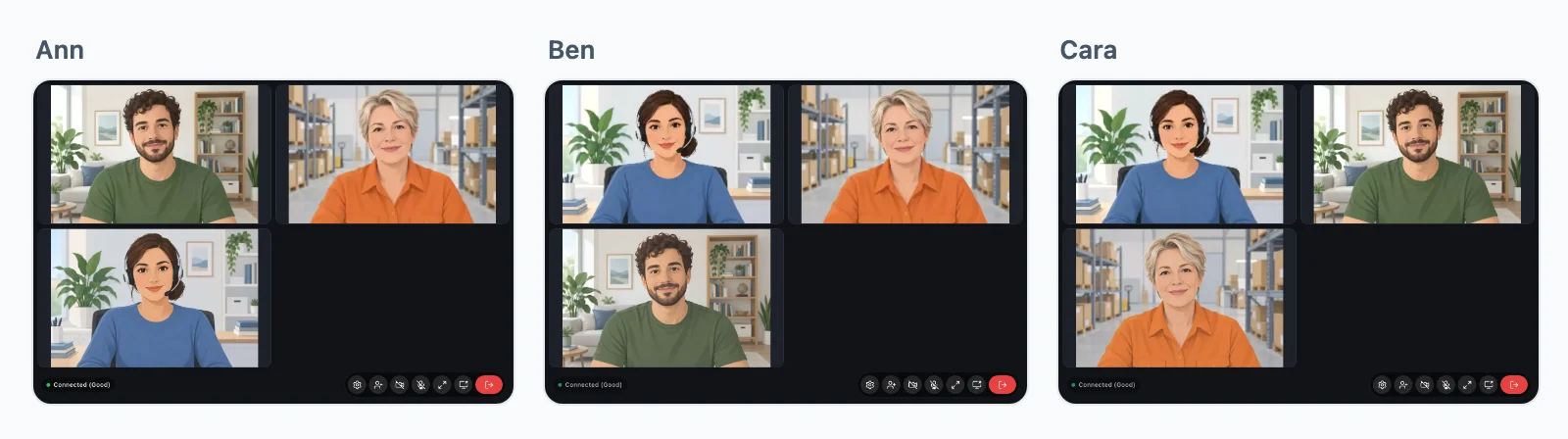
Otwórz tutaj pokój i zaproś maksymalnie trzy kolejne osoby z ich telefonów lub innych okien. Konto nie jest potrzebne.
To ekrany, które SDK daje Twojej aplikacji. Przeglądarka poprosi o kamerę i mikrofon, nic nie jest nagrywane, a demo kończy się po 10 minutach.
Rozmowy grupowe
Rozmowy grupowe na naszych serwerach mediów
Spotkania, lekcje, panele i pokoje audio działają na naszych serwerach mediów, a nie między urządzeniami, więc każde urządzenie wysyła swoją kamerę raz, bez względu na liczbę osób w rozmowie.
Bez limitu osób
Każda osoba w rozmowie grupowej wysyła swoją kamerę, mikrofon i ekran raz, a nasze serwery mediów przekazują je wszystkim pozostałym, w kilku regionach.
Mówcy i słuchacze
Twój serwer mówi, kto nadaje, a kto tylko ogląda i słucha, jak na lekcji czy w panelu. Gospodarz pozwala słuchaczowi mówić, a potem znów robi go słuchaczem.
Gospodarze pilnują porządku
Gospodarz wycisza mikrofon, pozwala komuś mówić i usuwa kogoś z rozmowy, z kafelka każdej osoby.
Decyduje Twój serwer
Poprowadź spotkanie, od początku do końca
Twój serwer mówi, kto dołącza i kto jest gospodarzem, a strona lub Twój serwer robi resztę. Oto spotkanie zespołu, a potem lekcja, zadanie po zadaniu.
Next.js na serwerze i React na stronie.
Daj stronie token
Rozmowa grupowa to tylko nazwa, na przykład meeting:7, i nic nie trzeba tworzyć w chmurze. Kto dołącza i kto jest gospodarzem, to własna logika Twojej aplikacji, więc trafia do Twojej własnej trasy, która odpowiada tokenem. isMemberOf i isLeadOf to Twoje własne funkcje sprawdzające.
export async function GET( request: Request ) {
    const me = await currentUserId();
    const id = new URL( request.url ).searchParams.get( 'id' )!;

    // Your own check: only its team, and its lead is the host.
    if ( ! me || ! await isMemberOf( id, me ) ) {
        return new Response( null, { status: 403 } );
    }

    const token = await realtime.groupCallToken( me, 'meeting:' + id, {
        admin: await isLeadOf( id, me ),
    } );

    return Response.json( { token } );
}app.get( '/api/meeting-token', async ( req, res ) => {
const me = userOf( req );
const { id } = req.query;
// Your own check: only its team, and its lead is the host.
if ( ! me || ! await isMemberOf( id, me ) ) {
return res.sendStatus( 403 );
}
const token = await realtime.groupCallToken( me, 'meeting:' + id, {
admin: await isLeadOf( id, me ),
} );
res.json( { token } );
} );import { createServer } from 'node:http';
createServer( async ( req, res ) => {
const url = new URL( req.url, 'http://localhost' );
if ( url.pathname === '/api/meeting-token' ) {
const me = userOf( req );
const id = url.searchParams.get( 'id' );
// Your own check: only its team, and its lead is the host.
if ( ! me || ! await isMemberOf( id, me ) ) {
res.writeHead( 403 );
return res.end();
}
const token = await realtime.groupCallToken( me, 'meeting:' + id, {
admin: await isLeadOf( id, me ),
} );
res.writeHead( 200, { 'Content-Type': 'application/json' } );
return res.end( JSON.stringify( { token } ) );
}
// Your pages, and realtime.node( userOf ) for the SDK's routes.
} ).listen( 3000 );use Illuminate\Http\Request;
use WordPlus\Realtime\Laravel\Facades\Realtime;
Route::get( '/api/meeting-token', function ( Request $request ) {
$me = $request->user()->id;
$id = $request->query( 'id' );
// Your own check: only its team, and its lead is the host.
abort_unless( is_member_of( $id, $me ), 403 );
return [ 'token' => Realtime::groupCallToken( $me, 'meeting:' . $id, [
'admin' => is_lead_of( $id, $me ),
] ) ];
} )->middleware( 'auth' );require __DIR__ . '/../src/realtime.php';
$me = current_user_id();
$id = $_GET['id'] ?? '';
// Your own check: only its team, and its lead is the host.
if ( ! $me || ! is_member_of( $id, $me ) ) {
http_response_code( 403 );
exit;
}
header( 'Content-Type: application/json' );
echo json_encode( [
'token' => $realtime->groupCallToken( $me, 'meeting:' . $id, [
'admin' => is_lead_of( $id, $me ),
] ),
] );from django.contrib.auth.decorators import login_required
from django.http import HttpResponseForbidden, JsonResponse
from .realtime import realtime
# In urls.py: path("api/meeting-token", views.meeting_token)
@login_required
def meeting_token(request):
me = request.user.id
id = request.GET["id"]
# Your own check: only its team, and its lead is the host.
if not is_member_of(id, me):
return HttpResponseForbidden()
token = realtime.group_call_token(
me, "meeting:" + id, admin=is_lead_of(id, me)
)
return JsonResponse({"token": token})from fastapi import Depends, HTTPException
from realtime import realtime
@app.get("/api/meeting-token")
def meeting_token(id: str, me: int = Depends(current_user_id)):
# Your own check: only its team, and its lead is the host.
if not me or not is_member_of(id, me):
raise HTTPException(403)
token = realtime.group_call_token(
me, "meeting:" + id, admin=is_lead_of(id, me)
)
return {"token": token}from flask import abort, request, session
from realtime import realtime
@app.get("/api/meeting-token")
def meeting_token():
me = session.get("user_id")
id = request.args["id"]
# Your own check: only its team, and its lead is the host.
if not me or not is_member_of(id, me):
abort(403)
token = realtime.group_call_token(
me, "meeting:" + id, admin=is_lead_of(id, me)
)
return {"token": token}// http.HandleFunc("GET /api/meeting-token", meetingToken)
func meetingToken(w http.ResponseWriter, r *http.Request) {
me := userOf(r)
id := r.URL.Query().Get("id")
// Your own check: only its team, and its lead is the host.
if me == "" || !isMemberOf(id, me) {
w.WriteHeader(403)
return
}
token := app.GroupCallToken(me, "meeting:"+id, wordplus.GroupPlace{
Admin: isLeadOf(id, me),
Info: profile(me),
})
reply(w, map[string]string{"token": token})
}Dodaj przycisk dołączania
Gotowy ekran: przycisk i okno rozmowy z każdym kafelkiem i elementem sterującym, bez kodu rozmowy. Przycisk prosi Twoją trasę o swój token.
Hooki i komponenty dla każdej aplikacji React, z dowolnym serwerem powyżej.
import { connect } from '@wordplus/realtime';

const rt = await connect();

// The call window, on every page a meeting may open from.
await rt.callScreen();

// And in the page. The button asks your route for its token.
// <group-call-button call="meeting:7" token-url="/api/meeting-token?id=7" type="video" title="Daily meeting">
//     Join the meeting
// </group-call-button>import { connect } from '@wordplus/realtime';
const rt = await connect();
// The call window, on every page a meeting may open from.
await rt.callScreen();
// And in the page. The button asks your route for its token.
// <group-call-button call="meeting:7" token-url="/api/meeting-token?id=7" type="video" title="Daily meeting">
// Join the meeting
// </group-call-button><group-call-button call="meeting:7" token-url="/api/meeting-token?id=7" type="video" title="Daily meeting">
Join the meeting
</group-call-button>
<script type="module">
// The call window, on every page a meeting may open from.
await window.Echo.connector.rt.callScreen();
</script>'use client'; // in Next.js
import { CallScreen, GroupCallButton } from '@wordplus/realtime/react';
// Inside <RealtimeProvider>, once for the whole app.
export function JoinMeeting() {
return (
<>
<CallScreen />
<GroupCallButton call="meeting:7" tokenUrl="/api/meeting-token?id=7" type="video" title="Daily meeting">
Join the meeting
</GroupCallButton>
</>
);
}<script setup>
import { watchEffect } from 'vue';
import { useRealtime } from '@wordplus/realtime/vue';
// provideRealtime() once, in your root component.
const rt = useRealtime();
// The call window, on every page a meeting may open from.
watchEffect( () => rt.value?.callScreen() );
</script>
<!-- isCustomElement for this tag, in vite.config.js -->
<template>
<group-call-button call="meeting:7" token-url="/api/meeting-token?id=7" type="video" title="Daily meeting">
Join the meeting
</group-call-button>
</template><script>
import { useRealtime } from '@wordplus/realtime/svelte';
// provideRealtime() once, in your root component.
const rt = useRealtime();
// The call window, on every page a meeting may open from.
$effect( () => { rt.current?.callScreen(); } );
</script>
<group-call-button call="meeting:7" token-url="/api/meeting-token?id=7" type="video" title="Daily meeting">
Join the meeting
</group-call-button>import { Component, CUSTOM_ELEMENTS_SCHEMA } from '@angular/core';
// realtime.ts, one connection for the whole app:
// export const realtime = connect();
import { realtime } from './realtime';
@Component( {
selector: 'app-join-meeting',
schemas: [ CUSTOM_ELEMENTS_SCHEMA ],
template: `<group-call-button call="meeting:7" token-url="/api/meeting-token?id=7" type="video" title="Daily meeting">Join the meeting</group-call-button>`,
} )
export class JoinMeetingComponent {
async ngOnInit() {
const rt = await realtime;
// The call window, on every page a meeting may open from.
await rt.callScreen();
}
}import WordPlusRealtimeCalls
import WordPlusRealtimeUI
let token = try await api.meetingToken(id: 7) // your own request to your route
let meeting = try await rt.joinGroupCall(token)
CallScreen.shared.show(meeting, title: "Daily meeting")import cloud.wordplus.realtime.calls.joinGroupCall
import cloud.wordplus.realtime.ui.CallScreen
val token = api.meetingToken(id = 7) // your own request to your route
val meeting = rt.joinGroupCall(context, token)
CallScreen.show(context, meeting, title = "Daily meeting")import {
CallScreen, GroupCallButton, RealtimeProvider,
} from '@wordplus/realtime-react-native';
// Your server, in full, as an app has no address of its own.
const API = 'https://app.example.com/api';
const options = {
app: 's1500000007',
endpoint: API + '/realtime',
headers: { Authorization: 'Bearer ' + session.token },
};
export function App() {
return (
<RealtimeProvider options={ options }>
<CallScreen />
<GroupCallButton call="meeting:7" type="video" title="Daily meeting"
tokenUrl={ API + '/meeting-token?id=7' }>
Join the meeting
</GroupCallButton>
</RealtimeProvider>
);
}import 'package:flutter/material.dart';
import 'package:wordplus_realtime/wordplus_realtime.dart';
// Your server, in full, as an app has no address of its own.
const api = 'https://app.example.com/api';
// Once, as your app starts.
final rt = await WordPlusRealtime.connect(
app: 's1500000007',
endpoint: '$api/realtime',
headers: {'Authorization': 'Bearer ${session.token}'},
);
// The call window.
await rt.callScreen();
// In your build:
GroupCallButton(
rt: rt,
call: 'meeting:7',
tokenUrl: '$api/meeting-token?id=7',
title: 'Daily meeting',
child: const Text('Join the meeting'),
)Umieść go na swojej stronie
Ten sam ekran w wybranym przez Ciebie miejscu, zamiast okna nad stroną, z dołączaniem przy otwarciu strony, jeśli chcesz.
Hooki i komponenty dla każdej aplikacji React, z dowolnym serwerem powyżej.
import { connect } from '@wordplus/realtime';

const rt = await connect();

await rt.callScreen();

// And in the page. The meeting opens here, with no window over it,
// joining as the page opens, the camera and microphone on:
// <call-spot call="meeting:7" token-url="/api/meeting-token?id=7" join="video" join-with="microphone camera"></call-spot>import { connect } from '@wordplus/realtime';
const rt = await connect();
await rt.callScreen();
// And in the page. The meeting opens here, with no window over it,
// joining as the page opens, the camera and microphone on:
// <call-spot call="meeting:7" token-url="/api/meeting-token?id=7" join="video" join-with="microphone camera"></call-spot><call-spot call="meeting:7" token-url="/api/meeting-token?id=7" join="video" join-with="microphone camera"></call-spot>
<script type="module">
await window.Echo.connector.rt.callScreen();
</script>'use client'; // in Next.js
import { CallScreen, CallSpot } from '@wordplus/realtime/react';
// Inside <RealtimeProvider>, once for the whole app.
export function Meeting() {
return (
<>
<CallScreen />
<CallSpot call="meeting:7" tokenUrl="/api/meeting-token?id=7" join="video" joinWith="microphone camera" />
</>
);
}<script setup>
import { watchEffect } from 'vue';
import { useRealtime } from '@wordplus/realtime/vue';
// provideRealtime() once, in your root component.
const rt = useRealtime();
watchEffect( () => rt.value?.callScreen() );
</script>
<!-- isCustomElement for this tag, in vite.config.js -->
<template>
<call-spot call="meeting:7" token-url="/api/meeting-token?id=7" join="video" join-with="microphone camera"></call-spot>
</template><script>
import { useRealtime } from '@wordplus/realtime/svelte';
// provideRealtime() once, in your root component.
const rt = useRealtime();
$effect( () => { rt.current?.callScreen(); } );
</script>
<call-spot call="meeting:7" token-url="/api/meeting-token?id=7" join="video" join-with="microphone camera"></call-spot>import { Component, CUSTOM_ELEMENTS_SCHEMA } from '@angular/core';
// realtime.ts, one connection for the whole app:
// export const realtime = connect();
import { realtime } from './realtime';
@Component( {
selector: 'app-meeting',
schemas: [ CUSTOM_ELEMENTS_SCHEMA ],
template: `<call-spot call="meeting:7" token-url="/api/meeting-token?id=7" join="video" join-with="microphone camera"></call-spot>`,
} )
export class MeetingComponent {
async ngOnInit() {
const rt = await realtime;
await rt.callScreen();
}
}Dołącz z własnego kodu
Dla ekranu, który rysujesz sam: pobierz token ze swojej trasy i dołącz z nim. Każda osoba przychodzi ze swoją kamerą i mikrofonem, a nic nie jest wysyłane, dopóki o to nie poprosisz.
Hooki i komponenty dla każdej aplikacji React, z dowolnym serwerem powyżej.
import { connect } from '@wordplus/realtime';

const rt = await connect();

// Asks your server for a token: your route from the first step.
async function meetingToken( id ) {
    const answer = await fetch( '/api/meeting-token?id=' + id );
    if ( ! answer.ok ) throw new Error( 'Your server said no' );

    return ( await answer.json() ).token;
}

const group = await rt.joinGroupCall( await meetingToken( 7 ) );

// tileFor() and removeTile() are your own: a <video> for each person.
group.on( 'person', ( person ) => person.camera?.attach( tileFor( person.user ) ) );
group.on( 'person_left', ( person ) => removeTile( person.user ) );

await group.setMicrophone( true );
await group.setCamera( true );

leave.onclick = () => group.leave();import { connect } from '@wordplus/realtime';
const rt = await connect();
// Asks your server for a token: your route from the first step.
async function meetingToken( id ) {
const answer = await fetch( '/api/meeting-token?id=' + id );
if ( ! answer.ok ) throw new Error( 'Your server said no' );
return ( await answer.json() ).token;
}
const group = await rt.joinGroupCall( await meetingToken( 7 ) );
// tileFor() and removeTile() are your own: a <video> for each person.
group.on( 'person', ( person ) => person.camera?.attach( tileFor( person.user ) ) );
group.on( 'person_left', ( person ) => removeTile( person.user ) );
await group.setMicrophone( true );
await group.setCamera( true );
leave.onclick = () => group.leave();const rt = window.Echo.connector.rt; // the connection Echo made
// Asks your server for a token: your route from the first step.
async function meetingToken( id ) {
const answer = await fetch( '/api/meeting-token?id=' + id );
if ( ! answer.ok ) throw new Error( 'Your server said no' );
return ( await answer.json() ).token;
}
const group = await rt.joinGroupCall( await meetingToken( 7 ) );
// tileFor() and removeTile() are your own: a <video> for each person.
group.on( 'person', ( person ) => person.camera?.attach( tileFor( person.user ) ) );
group.on( 'person_left', ( person ) => removeTile( person.user ) );
await group.setMicrophone( true );
await group.setCamera( true );
leave.onclick = () => group.leave();'use client'; // in Next.js
import { AudioTrack, useGroupCall, VideoTrack } from '@wordplus/realtime/react';
// Asks your server for a token: your route from the first step.
async function meetingToken( id ) {
const answer = await fetch( '/api/meeting-token?id=' + id );
if ( ! answer.ok ) throw new Error( 'Your server said no' );
return ( await answer.json() ).token;
}
// Inside <RealtimeProvider>, once for the whole app.
export function Meeting() {
const { people, camera, setCamera, setMicrophone } = useGroupCall( 'meeting:7', () => meetingToken( 7 ) );
return (
<>
{ people.map( ( person ) => (
<div key={ person.user }>
<VideoTrack track={ person.camera } />
<AudioTrack track={ person.microphone } />
</div>
) ) }
<VideoTrack track={ camera } />
<button onClick={ () => setCamera( ! camera ) }>Camera</button>
<button onClick={ () => setMicrophone( true ) }>Microphone</button>
</>
);
}<script setup>
import { AudioTrack, useGroupCall, VideoTrack } from '@wordplus/realtime/vue';
// Asks your server for a token: your route from the first step.
async function meetingToken( id ) {
const answer = await fetch( '/api/meeting-token?id=' + id );
if ( ! answer.ok ) throw new Error( 'Your server said no' );
return ( await answer.json() ).token;
}
// provideRealtime() once, in your root component.
const { people, camera, setCamera, setMicrophone } = useGroupCall( 'meeting:7', () => meetingToken( 7 ) );
</script>
<template>
<div v-for="person in people" :key="person.user">
<VideoTrack :track="person.camera" />
<AudioTrack :track="person.microphone" />
</div>
<VideoTrack :track="camera" />
<button @click="setCamera( ! camera )">Camera</button>
<button @click="setMicrophone( true )">Microphone</button>
</template><script>
import { track, useGroupCall } from '@wordplus/realtime/svelte';
// Asks your server for a token: your route from the first step.
async function meetingToken( id ) {
const answer = await fetch( '/api/meeting-token?id=' + id );
if ( ! answer.ok ) throw new Error( 'Your server said no' );
return ( await answer.json() ).token;
}
// provideRealtime() once, in your root component.
const meeting = useGroupCall( 'meeting:7', () => meetingToken( 7 ) );
</script>
{#each meeting.people as person (person.user)}
<video use:track={ person.camera } muted autoplay playsinline></video>
<audio use:track={ person.microphone } autoplay></audio>
{/each}
<video use:track={ meeting.camera } muted autoplay playsinline></video>
<button onclick={ () => meeting.setCamera( ! meeting.camera ) }>Camera</button>
<button onclick={ () => meeting.setMicrophone( true ) }>Microphone</button>import { Component, CUSTOM_ELEMENTS_SCHEMA } from '@angular/core';
// realtime.ts, one connection for the whole app:
// export const realtime = connect();
import { realtime } from './realtime';
@Component( {
selector: 'app-meeting',
schemas: [ CUSTOM_ELEMENTS_SCHEMA ],
template: `<!-- Your tiles here -->`,
} )
export class MeetingComponent {
async ngOnInit() {
const rt = await realtime;
// Asks your server for a token: your route from the first step.
async function meetingToken( id ) {
const answer = await fetch( '/api/meeting-token?id=' + id );
if ( ! answer.ok ) throw new Error( 'Your server said no' );
return ( await answer.json() ).token;
}
const group = await rt.joinGroupCall( await meetingToken( 7 ) );
// tileFor() and removeTile() are your own: a <video> for each person.
group.on( 'person', ( person ) => person.camera?.attach( tileFor( person.user ) ) );
group.on( 'person_left', ( person ) => removeTile( person.user ) );
await group.setMicrophone( true );
await group.setCamera( true );
leave.onclick = () => group.leave();
}
}let token = try await api.meetingToken(id: 7) // your own request to your route
let group = try await rt.joinGroupCall(token)
group.setMicrophone(true) // nothing is sent until asked
group.setCamera(true)
// tile(for:) is your own: a GroupVideoView for each person.
group.onPeople {
for person in group.people { tile(for: person).show(person.identity, of: group) }
}
leave.addAction(UIAction { _ in group.leave() }, for: .touchUpInside)val token = api.meetingToken(id = 7) // your own request to your route
val group = rt.joinGroupCall(context, token)
group.setMicrophone(true) // nothing is sent until asked
group.setCamera(true)
// tileFor() is your own: a GroupVideoView for each person.
group.onPeople {
for (person in group.people) tileFor(person).show(person.identity, group)
}
leave.setOnClickListener { group.leave() }import { Button, Text, View } from 'react-native';
import { GroupVideo, useGroupCall, useRealtime } from '@wordplus/realtime-react-native';
const API = 'https://app.example.com/api'; // your server, in full
// Inside <RealtimeProvider>, once for the whole app.
export function Meeting() {
const rt = useRealtime();
// Asks your route from the first step, once connected.
const { group, state, error } = useGroupCall( 'meeting:7', () => rt.tokenFrom( API + '/meeting-token', { id: 7 } ) );
if ( ! state ) return <Text>{ error ?? 'Joining…' }</Text>;
return (
<View>
{ state.people.map( ( person ) => (
<GroupVideo key={ person.identity } group={ group } person={ person.identity } style={ { aspectRatio: 16 / 9 } } />
) ) }
<GroupVideo group={ group } source="own" mirrored style={ { height: 120 } } />
<Button title="Camera" onPress={ () => group.setCamera( ! state.camera ) } />
<Button title="Microphone" onPress={ () => group.setMicrophone( ! state.microphone ) } />
</View>
);
}final token = await rt.tokenFrom('$api/meeting-token', {'id': 7});
final group = await rt.joinGroupCall(token);
await group.setMicrophone(true); // nothing is sent until asked
await group.setCamera(true);
// In your build:
ListenableBuilder(
listenable: group, // someone arrives or leaves, or what they send changes
builder: (context, _) => GridView.count(crossAxisCount: 2, children: [
for (final person in group.people)
GroupVideo(key: ValueKey(person.identity), group: group, person: person.identity),
GroupVideo(group: group, source: GroupVideoSource.own, mirrored: true),
]),
)Kamera, mikrofon i ekran
Te same polecenia w rozmowie, rozmowie grupowej i transmisji na żywo, więc Twój ekran nie musi śledzić żadnego urządzenia. Kamera zatrzymuje się, a jej lampka gaśnie, gdy zostanie wyłączona lub gdy rozmowa się skończy.
Hooki i komponenty dla każdej aplikacji React, z dowolnym serwerem powyżej.
import { connect } from '@wordplus/realtime';

const rt = await connect();

await group.setMicrophone( false );                  // muted
await group.setCamera( false );                      // stopped, and the light goes off
const shared = await group.setScreenShare( true );   // false if they picked nothing

// Move to another camera with no gap for the others.
const { cameras } = await group.devices();
await group.setCamera( true, { deviceId: cameras[ 1 ].id } );import { connect } from '@wordplus/realtime';
const rt = await connect();
await group.setMicrophone( false ); // muted
await group.setCamera( false ); // stopped, and the light goes off
const shared = await group.setScreenShare( true ); // false if they picked nothing
// Move to another camera with no gap for the others.
const { cameras } = await group.devices();
await group.setCamera( true, { deviceId: cameras[ 1 ].id } );const rt = window.Echo.connector.rt; // the connection Echo made
await group.setMicrophone( false ); // muted
await group.setCamera( false ); // stopped, and the light goes off
const shared = await group.setScreenShare( true ); // false if they picked nothing
// Move to another camera with no gap for the others.
const { cameras } = await group.devices();
await group.setCamera( true, { deviceId: cameras[ 1 ].id } );// In the component that holds the meeting, on the same useGroupCall().
const { camera, microphone, screen, setCamera, setMicrophone, setScreenShare } = useGroupCall( 'meeting:7', () => meetingToken( 7 ) );
return (
<>
<button onClick={ () => setMicrophone( ! microphone ) }>Microphone</button>
<button onClick={ () => setCamera( ! camera ) }>Camera</button>
<button onClick={ () => setScreenShare( ! screen ) }>Share screen</button>
</>
);<script setup>
// In the component that holds the meeting, on the same useGroupCall().
const { camera, microphone, screen, setCamera, setMicrophone, setScreenShare } = useGroupCall( 'meeting:7', () => meetingToken( 7 ) );
</script>
<template>
<button @click="setMicrophone( ! microphone )">Microphone</button>
<button @click="setCamera( ! camera )">Camera</button>
<button @click="setScreenShare( ! screen )">Share screen</button>
</template><!-- In the component that holds the meeting, on the same useGroupCall(). -->
<button onclick={ () => meeting.setMicrophone( ! meeting.microphone ) }>Microphone</button>
<button onclick={ () => meeting.setCamera( ! meeting.camera ) }>Camera</button>
<button onclick={ () => meeting.setScreenShare( ! meeting.screen ) }>Share screen</button>import { Component, CUSTOM_ELEMENTS_SCHEMA } from '@angular/core';
// realtime.ts, one connection for the whole app:
// export const realtime = connect();
import { realtime } from './realtime';
@Component( {
selector: 'app-controls',
schemas: [ CUSTOM_ELEMENTS_SCHEMA ],
template: `<!-- Your buttons here -->`,
} )
export class ControlsComponent {
async ngOnInit() {
const rt = await realtime;
await group.setMicrophone( false ); // muted
await group.setCamera( false ); // stopped, and the light goes off
const shared = await group.setScreenShare( true ); // false if they picked nothing
// Move to another camera with no gap for the others.
const { cameras } = await group.devices();
await group.setCamera( true, { deviceId: cameras[ 1 ].id } );
}
}group.setMicrophone(false) // muted
group.setCamera(false) // stops sending the camera
group.flipCamera() // the front one to the back, and back
// Puts up the system's picker, in an app built with the broadcast extension.
await group.setScreenShare(true)group.setMicrophone(false) // muted
group.setCamera(false) // stops sending the camera
group.flipCamera() // the front one to the back, and back
// answer is what the system's dialog gave: ScreenShare.permissionIntent(activity).
group.setScreenShare(true, answer.data)// In the component that holds the meeting, on the same useGroupCall().
const { group, state } = useGroupCall( 'meeting:7', () => rt.tokenFrom( API + '/meeting-token', { id: 7 } ) );
// Sharing the phone's screen isn't in React Native yet.
return (
<>
<Button title="Microphone" onPress={ () => group?.setMicrophone( ! state.microphone ) } />
<Button title="Camera" onPress={ () => group?.setCamera( ! state.camera ) } />
<Button title="Flip camera" onPress={ () => group?.flipCamera() } />
</>
);await group.setMicrophone(false); // muted
await group.setCamera(false); // stops sending the camera
await group.flipCamera(); // the front one to the back, and back
// Android asks with the system's dialog, iOS needs the broadcast extension.
final shared = await group.setScreenShare(true); // false if they said noMówcy i słuchacze
Lekcja, panel lub pokój audio: kilka osób mówi, a reszta słucha. Twoja trasa wskazuje słuchaczy, a Twój serwer pozwala jednemu z nich mówić w trakcie rozmowy, zapisując ten wybór tam, gdzie trasa odczyta go dla osób dołączających później.
// Your route, as in the first step, for /api/class-token?id=7.
const teacher = await isTeacherOf( id, me );
if ( ! teacher && ! await isStudentOf( id, me ) ) return refuse();

const token = await realtime.groupCallToken( me, 'class:' + id, {
    type: 'audio',
    admin: teacher,
    publish: teacher || await maySpeak( id, me ),   // a student listens until let speak
} );// The teacher's Let speak button, in a route that checks it is the teacher.
await setMaySpeak( 7, 34, true ); // where your route reads it
await realtime.call( 'class:7' ).letSpeak( 34 ); // and at once in the call// Your route, as in the first step, for /api/class-token?id=7.
const teacher = await isTeacherOf( id, me );
if ( ! teacher && ! await isStudentOf( id, me ) ) return refuse();
const token = await realtime.groupCallToken( me, 'class:' + id, {
type: 'audio',
admin: teacher,
publish: teacher || await maySpeak( id, me ), // a student listens until let speak
} );
// The teacher's Let speak button, in a route that checks it is the teacher.
await setMaySpeak( 7, 34, true );                // where your route reads it
await realtime.call( 'class:7' ).letSpeak( 34 ); // and at once in the call// Your route, as in the first step, for /api/class-token?id=7.
const teacher = await isTeacherOf( id, me );
if ( ! teacher && ! await isStudentOf( id, me ) ) return refuse();
const token = await realtime.groupCallToken( me, 'class:' + id, {
type: 'audio',
admin: teacher,
publish: teacher || await maySpeak( id, me ), // a student listens until let speak
} );
// The teacher's Let speak button, in a route that checks it is the teacher.
await setMaySpeak( 7, 34, true ); // where your route reads it
await realtime.call( 'class:7' ).letSpeak( 34 ); // and at once in the call// Your route, as in the first step, for /api/class-token?id=7.
$teacher = is_teacher_of( $id, $me );
abort_unless( $teacher || is_student_of( $id, $me ), 403 );
$token = Realtime::groupCallToken( $me, 'class:' . $id, [
'type' => 'audio',
'admin' => $teacher,
'publish' => $teacher || may_speak( $id, $me ), // a student listens until let speak
] );// The teacher's Let speak button, in a route that checks it is the teacher.
set_may_speak( 7, 34, true ); // where your route reads it
Realtime::call( 'class:7' )->letSpeak( 34 ); // and at once in the call// Your route, as in the first step, for /class-token.php?id=7.
$teacher = is_teacher_of( $id, $me );
if ( ! $teacher && ! is_student_of( $id, $me ) ) {
http_response_code( 403 );
exit;
}
$token = $realtime->groupCallToken( $me, 'class:' . $id, [
'type' => 'audio',
'admin' => $teacher,
'publish' => $teacher || may_speak( $id, $me ), // a student listens until let speak
] );// The teacher's Let speak button, in a route that checks it is the teacher.
set_may_speak( 7, 34, true ); // where your route reads it
$realtime->call( 'class:7' )->letSpeak( 34 ); // and at once in the call# Your route, as in the first step, for /api/class-token?id=7.
teacher = is_teacher_of(id, me)
if not teacher and not is_student_of(id, me):
return refuse()
token = realtime.group_call_token(
me,
"class:" + id,
type="audio",
admin=teacher,
publish=teacher or may_speak(id, me), # a student listens until let speak
)
# The teacher's Let speak button, in a route that checks it is the teacher.
set_may_speak(7, 34, True) # where your route reads it
realtime.call("class:7").let_speak(34) # and at once in the call# Your route, as in the first step, for /api/class-token?id=7.
teacher = is_teacher_of(id, me)
if not teacher and not is_student_of(id, me):
return refuse()
token = realtime.group_call_token(
me,
"class:" + id,
type="audio",
admin=teacher,
publish=teacher or may_speak(id, me), # a student listens until let speak
)
# In a def route, as these calls block.
# The teacher's Let speak button, in a route that checks it is the teacher.
set_may_speak(7, 34, True) # where your route reads it
realtime.call("class:7").let_speak(34) # and at once in the call# Your route, as in the first step, for /api/class-token?id=7.
teacher = is_teacher_of(id, me)
if not teacher and not is_student_of(id, me):
return refuse()
token = realtime.group_call_token(
me,
"class:" + id,
type="audio",
admin=teacher,
publish=teacher or may_speak(id, me), # a student listens until let speak
)
# The teacher's Let speak button, in a route that checks it is the teacher.
set_may_speak(7, 34, True) # where your route reads it
realtime.call("class:7").let_speak(34) # and at once in the call// Your route, as in the first step, for /api/class-token?id=7.
teacher := isTeacherOf(id, me)
if !teacher && !isStudentOf(id, me) {
w.WriteHeader(403)
return
}
token := app.GroupCallToken(me, "class:"+id, wordplus.GroupPlace{
Kind: "audio",
Admin: teacher,
Listener: !teacher && !maySpeak(id, me), // a student listens until let speak
Info: profile(me),
})# The teacher's Let speak button, in a route that checks it is the teacher.
wordplus POST '/wordplus/realtime/calls/class%3A7/permit' '{"user":"34","publish":true}'Hooki i komponenty dla każdej aplikacji React, z dowolnym serwerem powyżej.
import { connect } from '@wordplus/realtime';

const rt = await connect();

const answer = await fetch( '/api/class-token?id=7' );
const group = await rt.joinGroupCall( ( await answer.json() ).token );

// Let on, it speaks. Back to listening, the microphone closes by itself.
group.on( 'permissions', ( { publish } ) => {
    if ( publish ) group.setMicrophone( true );
} );

// Everyone sees who may speak.
group.on( 'person', ( person ) => place( person, person.publish ? speakers : listeners ) );import { connect } from '@wordplus/realtime';
const rt = await connect();
const answer = await fetch( '/api/class-token?id=7' );
const group = await rt.joinGroupCall( ( await answer.json() ).token );
// Let on, it speaks. Back to listening, the microphone closes by itself.
group.on( 'permissions', ( { publish } ) => {
if ( publish ) group.setMicrophone( true );
} );
// Everyone sees who may speak.
group.on( 'person', ( person ) => place( person, person.publish ? speakers : listeners ) );const rt = window.Echo.connector.rt; // the connection Echo made
const answer = await fetch( '/api/class-token?id=7' );
const group = await rt.joinGroupCall( ( await answer.json() ).token );
// Let on, it speaks. Back to listening, the microphone closes by itself.
group.on( 'permissions', ( { publish } ) => {
if ( publish ) group.setMicrophone( true );
} );
// Everyone sees who may speak.
group.on( 'person', ( person ) => place( person, person.publish ? speakers : listeners ) );'use client'; // in Next.js
import { useEffect } from 'react';
import { useGroupCall } from '@wordplus/realtime/react';
// Asks your server for a token: your route for the class.
const classToken = async () => ( await ( await fetch( '/api/class-token?id=7' ) ).json() ).token;
// Inside <RealtimeProvider>, once for the whole app.
export function ClassRoom() {
const { group, people } = useGroupCall( 'class:7', classToken );
// Let on, it speaks. Back to listening, the microphone closes by itself.
useEffect( () => {
const speak = ( { publish } ) => publish && group?.setMicrophone( true );
group?.on( 'permissions', speak );
return () => { group?.off( 'permissions', speak ); };
}, [ group ] );
return <People speakers={ people.filter( ( person ) => person.publish ) } />;
}<script setup>
import { computed, watch } from 'vue';
import { useGroupCall } from '@wordplus/realtime/vue';
// Asks your server for a token: your route for the class.
const classToken = async () => ( await ( await fetch( '/api/class-token?id=7' ) ).json() ).token;
// provideRealtime() once, in your root component.
const { group, people } = useGroupCall( 'class:7', classToken );
// Let on, it speaks. Back to listening, the microphone closes by itself.
watch( group, ( now ) => {
now?.on( 'permissions', ( { publish } ) => publish && now.setMicrophone( true ) );
} );
const speakers = computed( () => people.value.filter( ( person ) => person.publish ) );
</script>
<template>
<People :speakers="speakers" />
</template><script>
import { useGroupCall } from '@wordplus/realtime/svelte';
// Asks your server for a token: your route for the class.
const classToken = async () => ( await ( await fetch( '/api/class-token?id=7' ) ).json() ).token;
// provideRealtime() once, in your root component.
const room = useGroupCall( 'class:7', classToken );
// Let on, it speaks. Back to listening, the microphone closes by itself.
$effect( () => {
room.group?.on( 'permissions', ( { publish } ) => publish && room.group.setMicrophone( true ) );
} );
</script>
<People speakers={ room.people.filter( ( person ) => person.publish ) } />import { Component, CUSTOM_ELEMENTS_SCHEMA } from '@angular/core';
// realtime.ts, one connection for the whole app:
// export const realtime = connect();
import { realtime } from './realtime';
@Component( {
selector: 'app-class-room',
schemas: [ CUSTOM_ELEMENTS_SCHEMA ],
template: `<!-- Your list here -->`,
} )
export class ClassRoomComponent {
async ngOnInit() {
const rt = await realtime;
const answer = await fetch( '/api/class-token?id=7' );
const group = await rt.joinGroupCall( ( await answer.json() ).token );
// Let on, it speaks. Back to listening, the microphone closes by itself.
group.on( 'permissions', ( { publish } ) => {
if ( publish ) group.setMicrophone( true );
} );
// Everyone sees who may speak.
group.on( 'person', ( person ) => place( person, person.publish ? speakers : listeners ) );
}
}let token = try await api.classToken(id: 7) // your own request to your route
let group = try await rt.joinGroupCall(token)
// Let on, it speaks. Back to listening, the media server took it down already.
group.onPermissions { can in
group.microphone = can.publish
}
let speakers = group.people.filter(\.publish)val token = api.classToken(id = 7) // your own request to your route
val group = rt.joinGroupCall(context, token)
// Let on, it speaks. Back to listening, the media server took it down already.
group.onPermissions { can ->
group.microphone = can.publish
}
val speakers = group.people.filter { it.publish }import { useEffect, useRef } from 'react';
import { useGroupCall, useRealtime } from '@wordplus/realtime-react-native';
const API = 'https://app.example.com/api'; // your server, in full
// Inside <RealtimeProvider>, once for the whole app.
export function ClassRoom() {
const rt = useRealtime();
const { group, state } = useGroupCall( 'class:7', () => rt.tokenFrom( API + '/class-token', { id: 7 } ) );
const letOn = state?.self?.publish;
const before = useRef( letOn );
// Let on, it speaks. Back to listening, the microphone closes by itself.
useEffect( () => {
if ( letOn && before.current === false ) group.setMicrophone( true );
before.current = letOn;
}, [ group, letOn ] );
return <People speakers={ state?.people.filter( ( person ) => person.publish ) } />;
}final token = await rt.tokenFrom('$api/class-token', {'id': 7});
final group = await rt.joinGroupCall(token);
// Let on, it speaks. Back to listening, the media server took it down already.
group.onPermissions((can) {
if (can.publish) group.setMicrophone(true);
});
final speakers = group.people.where((person) => person.publish);Wyciszaj i usuwaj osoby
Gospodarz robi to ze strony, na tyle, na ile pozwala mu jego token. Ekran rozmowy ma te czynności na każdym kafelku.
Hooki i komponenty dla każdej aplikacji React, z dowolnym serwerem powyżej.
import { connect } from '@wordplus/realtime';

const rt = await connect();

// For the one your token made the host. Anyone else is refused forbidden.
if ( group.can.admin ) {
    await group.mute( 34 );           // their microphone off, which they may turn on again
    await group.makeListener( 34 );   // sends nothing, until let speak
    await group.letSpeak( 34 );
    await group.remove( 34 );         // out of the call
}import { connect } from '@wordplus/realtime';
const rt = await connect();
// For the one your token made the host. Anyone else is refused forbidden.
if ( group.can.admin ) {
await group.mute( 34 ); // their microphone off, which they may turn on again
await group.makeListener( 34 ); // sends nothing, until let speak
await group.letSpeak( 34 );
await group.remove( 34 ); // out of the call
}const rt = window.Echo.connector.rt; // the connection Echo made
// For the one your token made the host. Anyone else is refused forbidden.
if ( group.can.admin ) {
await group.mute( 34 ); // their microphone off, which they may turn on again
await group.makeListener( 34 ); // sends nothing, until let speak
await group.letSpeak( 34 );
await group.remove( 34 ); // out of the call
}// In the component that holds the meeting, on the same useGroupCall().
const { group } = useGroupCall( 'meeting:7', () => meetingToken( 7 ) );
// For the one your token made the host. Anyone else is refused forbidden.
if ( group?.can.admin ) {
return (
<>
<button onClick={ () => group.mute( 34 ) }>Mute</button>
<button onClick={ () => group.makeListener( 34 ) }>Make a listener</button>
<button onClick={ () => group.remove( 34 ) }>Remove</button>
</>
);
}<script setup>
// In the component that holds the meeting, on the same useGroupCall().
const { group } = useGroupCall( 'meeting:7', () => meetingToken( 7 ) );
</script>
<template>
<!-- For the one your token made the host. Anyone else is refused forbidden. -->
<template v-if="group?.can.admin">
<button @click="group.mute( 34 )">Mute</button>
<button @click="group.makeListener( 34 )">Make a listener</button>
<button @click="group.remove( 34 )">Remove</button>
</template>
</template><!-- In the component that holds the meeting, on the same useGroupCall(). -->
<!-- For the one your token made the host. Anyone else is refused forbidden. -->
{#if meeting.group?.can.admin}
<button onclick={ () => meeting.group.mute( 34 ) }>Mute</button>
<button onclick={ () => meeting.group.makeListener( 34 ) }>Make a listener</button>
<button onclick={ () => meeting.group.remove( 34 ) }>Remove</button>
{/if}import { Component, CUSTOM_ELEMENTS_SCHEMA } from '@angular/core';
// realtime.ts, one connection for the whole app:
// export const realtime = connect();
import { realtime } from './realtime';
@Component( {
selector: 'app-host',
schemas: [ CUSTOM_ELEMENTS_SCHEMA ],
template: `<!-- Your buttons here -->`,
} )
export class HostComponent {
async ngOnInit() {
const rt = await realtime;
// Asks your server for a token: your route from the first step.
async function meetingToken( id ) {
const answer = await fetch( '/api/meeting-token?id=' + id );
if ( ! answer.ok ) throw new Error( 'Your server said no' );
return ( await answer.json() ).token;
}
const group = await rt.joinGroupCall( await meetingToken( 7 ) );
// For the one your token made the host. Anyone else is refused forbidden.
if ( group.can.admin ) {
await group.mute( 34 ); // their microphone off, which they may turn on again
await group.makeListener( 34 ); // sends nothing, until let speak
await group.letSpeak( 34 );
await group.remove( 34 ); // out of the call
}
}
}// For the one your token made the host. Anyone else is refused forbidden.
if group.can.admin {
try await group.mute("34") // their microphone off, which they may turn on again
try await group.makeListener("34") // sends nothing, until let speak
try await group.letSpeak("34")
try await group.remove("34") // out of the call
}// For the one your token made the host. Anyone else is refused forbidden.
if (group.can.admin) {
group.mute("34") // their microphone off, which they may turn on again
group.makeListener("34") // sends nothing, until let speak
group.letSpeak("34")
group.remove("34") // out of the call
}// In the component that holds the meeting, on the same useGroupCall().
const { group, state } = useGroupCall( 'meeting:7', () => rt.tokenFrom( API + '/meeting-token', { id: 7 } ) );
// For the one your token made the host. Anyone else is refused forbidden.
if ( state?.can.admin ) {
return (
<>
<Button title="Mute" onPress={ () => group.mute( '34' ) } />
<Button title="Make a listener" onPress={ () => group.makeListener( '34' ) } />
<Button title="Let speak" onPress={ () => group.letSpeak( '34' ) } />
<Button title="Remove" onPress={ () => group.remove( '34' ) } />
</>
);
}// For the one your token made the host. Anyone else is refused forbidden.
if (group.can.admin) {
await group.mute('34'); // their microphone off, which they may turn on again
await group.makeListener('34'); // sends nothing, until let speak
await group.letSpeak('34');
await group.remove('34'); // out of the call
}Wyróżnij kogoś
Umieszcza kogoś na głównych kafelkach u wszystkich, do czterech osób, także gospodarza.
Hooki i komponenty dla każdej aplikacji React, z dowolnym serwerem powyżej.
import { connect } from '@wordplus/realtime';

const rt = await connect();

// On the main tiles for everyone, up to four people.
await group.spotlightOn( 34 );

group.on( 'spotlit', ( users ) => redraw( users ) );

await group.spotlightOff( 34 ); // or spotlightOff() for everyoneimport { connect } from '@wordplus/realtime';
const rt = await connect();
// On the main tiles for everyone, up to four people.
await group.spotlightOn( 34 );
group.on( 'spotlit', ( users ) => redraw( users ) );
await group.spotlightOff( 34 ); // or spotlightOff() for everyoneimport { connect } from '@wordplus/realtime';
const rt = await connect();
// On the main tiles for everyone, up to four people.
await group.spotlightOn( 34 );
group.on( 'spotlit', ( users ) => redraw( users ) );
await group.spotlightOff( 34 ); // or spotlightOff() for everyoneimport { connect } from '@wordplus/realtime';
const rt = await connect();
// On the main tiles for everyone, up to four people.
await group.spotlightOn( 34 );
group.on( 'spotlit', ( users ) => redraw( users ) );
await group.spotlightOff( 34 ); // or spotlightOff() for everyoneimport { connect } from '@wordplus/realtime';
const rt = await connect();
// On the main tiles for everyone, up to four people.
await group.spotlightOn( 34 );
group.on( 'spotlit', ( users ) => redraw( users ) );
await group.spotlightOff( 34 ); // or spotlightOff() for everyoneimport { connect } from '@wordplus/realtime';
const rt = await connect();
// On the main tiles for everyone, up to four people.
await group.spotlightOn( 34 );
group.on( 'spotlit', ( users ) => redraw( users ) );
await group.spotlightOff( 34 ); // or spotlightOff() for everyoneimport { connect } from '@wordplus/realtime';
const rt = await connect();
// On the main tiles for everyone, up to four people.
await group.spotlightOn( 34 );
group.on( 'spotlit', ( users ) => redraw( users ) );
await group.spotlightOff( 34 ); // or spotlightOff() for everyoneimport { connect } from '@wordplus/realtime';
const rt = await connect();
// On the main tiles for everyone, up to four people.
await group.spotlightOn( 34 );
group.on( 'spotlit', ( users ) => redraw( users ) );
await group.spotlightOff( 34 ); // or spotlightOff() for everyoneimport { connect } from '@wordplus/realtime';
const rt = await connect();
// On the main tiles for everyone, up to four people.
await group.spotlightOn( 34 );
group.on( 'spotlit', ( users ) => redraw( users ) );
await group.spotlightOff( 34 ); // or spotlightOff() for everyoneconst rt = window.Echo.connector.rt; // the connection Echo made
// On the main tiles for everyone, up to four people.
await group.spotlightOn( 34 );
group.on( 'spotlit', ( users ) => redraw( users ) );
await group.spotlightOff( 34 ); // or spotlightOff() for everyone// In the component that holds the meeting, on the same useGroupCall().
const { group } = useGroupCall( 'meeting:7', () => meetingToken( 7 ) );
// On the main tiles for everyone, up to four people. group.spotlit names them.
return (
<>
<button onClick={ () => group?.spotlightOn( 34 ) }>Spotlight</button>
<button onClick={ () => group?.spotlightOff( 34 ) }>Remove spotlight</button>
</>
);<script setup>
// In the component that holds the meeting, on the same useGroupCall().
const { group } = useGroupCall( 'meeting:7', () => meetingToken( 7 ) );
</script>
<template>
<!-- On the main tiles for everyone, up to four people. group.spotlit names them. -->
<button @click="group?.spotlightOn( 34 )">Spotlight</button>
<button @click="group?.spotlightOff( 34 )">Remove spotlight</button>
</template><!-- In the component that holds the meeting, on the same useGroupCall(). -->
<!-- On the main tiles for everyone, up to four people. group.spotlit names them. -->
<button onclick={ () => meeting.group?.spotlightOn( 34 ) }>Spotlight</button>
<button onclick={ () => meeting.group?.spotlightOff( 34 ) }>Remove spotlight</button>import { Component, CUSTOM_ELEMENTS_SCHEMA } from '@angular/core';
// realtime.ts, one connection for the whole app:
// export const realtime = connect();
import { realtime } from './realtime';
@Component( {
selector: 'app-spotlight',
schemas: [ CUSTOM_ELEMENTS_SCHEMA ],
template: `<!-- Your buttons here -->`,
} )
export class SpotlightComponent {
async ngOnInit() {
const rt = await realtime;
// Asks your server for a token: your route from the first step.
async function meetingToken( id ) {
const answer = await fetch( '/api/meeting-token?id=' + id );
if ( ! answer.ok ) throw new Error( 'Your server said no' );
return ( await answer.json() ).token;
}
const group = await rt.joinGroupCall( await meetingToken( 7 ) );
// On the main tiles for everyone, up to four people.
await group.spotlightOn( 34 );
group.on( 'spotlit', ( users ) => redraw( users ) );
await group.spotlightOff( 34 ); // or spotlightOff() for everyone
}
}// On the main tiles for everyone, up to four people.
try await group.spotlightOn("34")
group.onSpotlit { users in redraw(users) }
try await group.spotlightOff("34") // or spotlightOff() for everyone// On the main tiles for everyone, up to four people.
group.spotlightOn("34")
group.onSpotlit { users -> redraw(users) }
group.spotlightOff("34") // or spotlightOff() for everyone// In the component that holds the meeting, on the same useGroupCall().
const { group, state } = useGroupCall( 'meeting:7', () => rt.tokenFrom( API + '/meeting-token', { id: 7 } ) );
// On the main tiles for everyone, up to four people. state.spotlit names them.
return (
<>
<Button title="Spotlight" onPress={ () => group?.spotlightOn( '34' ) } />
<Button title="Remove spotlight" onPress={ () => group?.spotlightOff( '34' ) } />
</>
);// On the main tiles for everyone, up to four people.
await group.spotlightOn('34');
group.onSpotlit((users) => redraw(users));
await group.spotlightOff('34'); // or spotlightOff() for everyoneZarządzaj nią ze swojego serwera
Zobacz, kto jest w rozmowie, i wycisz, zrób słuchaczem lub usuń dowolną osobę, bez otwartej strony. Usunięta osoba zostaje na zewnątrz, dopóki Twój serwer nie podpisze jej nowego tokenu.
// No page needs to be open. Check who asks, in your own route.
const call = realtime.call( 'meeting:7' );

await call.get();              // { people, started_at, list: [ { user, camera, microphone, screen } ] }
await call.mute( 34 );         // or mute( 34, 'camera' ), mute( 34, 'screen' )
await call.makeListener( 34 ); // sends nothing, until letSpeak( 34 )
await call.remove( 34 );       // out now

await realtime.listCalls(); // every group call going on: [ { name, people, started_at } ]// No page needs to be open. Check who asks, in your own route.
const call = realtime.call( 'meeting:7' );
await call.get(); // { people, started_at, list: [ { user, camera, microphone, screen } ] }
await call.mute( 34 ); // or mute( 34, 'camera' ), mute( 34, 'screen' )
await call.makeListener( 34 ); // sends nothing, until letSpeak( 34 )
await call.remove( 34 ); // out now
await realtime.listCalls(); // every group call going on: [ { name, people, started_at } ]// No page needs to be open. Check who asks, in your own route.
$call = Realtime::call( 'meeting:7' );
$call->get(); // [ 'people', 'started_at', 'list' => [ [ 'user', 'camera', 'microphone', 'screen' ] ] ]
$call->mute( 34 ); // or mute( 34, 'camera' ), mute( 34, 'screen' )
$call->makeListener( 34 ); // sends nothing, until letSpeak( 34 )
$call->remove( 34 ); // out now
Realtime::listCalls(); // every group call going on// No page needs to be open. Check who asks, in your own route.
$call = $realtime->call( 'meeting:7' );
$call->get(); // [ 'people', 'started_at', 'list' => [ [ 'user', 'camera', 'microphone', 'screen' ] ] ]
$call->mute( 34 ); // or mute( 34, 'camera' ), mute( 34, 'screen' )
$call->makeListener( 34 ); // sends nothing, until letSpeak( 34 )
$call->remove( 34 ); // out now
$realtime->listCalls(); // every group call going on# No page needs to be open. Check who asks, in your own route.
call = realtime.call("meeting:7")
call.get() # {"people", "started_at", "list": [{"user", "camera", "microphone", "screen"}]}
call.mute(34) # or mute(34, "camera"), mute(34, "screen")
call.make_listener(34) # sends nothing, until let_speak(34)
call.remove(34) # out now
realtime.list_calls() # every group call going on# In a def route, as these calls block.
# No page needs to be open. Check who asks, in your own route.
call = realtime.call("meeting:7")

call.get()                # {"people", "started_at", "list": [{"user", "camera", "microphone", "screen"}]}
call.mute(34)             # or mute(34, "camera"), mute(34, "screen")
call.make_listener(34)    # sends nothing, until let_speak(34)
call.remove(34)           # out now

realtime.list_calls() # every group call going on# No page needs to be open. Check who asks, in your own route.
call = realtime.call("meeting:7")
call.get() # {"people", "started_at", "list": [{"user", "camera", "microphone", "screen"}]}
call.mute(34) # or mute(34, "camera"), mute(34, "screen")
call.make_listener(34) # sends nothing, until let_speak(34)
call.remove(34) # out now
realtime.list_calls() # every group call going on# No page needs to be open. Check who asks, in your own route.
wordplus GET '/wordplus/realtime/calls/meeting%3A7'
wordplus POST '/wordplus/realtime/calls/meeting%3A7/mute' '{"user":"34","track":"microphone"}'
wordplus POST '/wordplus/realtime/calls/meeting%3A7/permit' '{"user":"34","publish":false}'
wordplus POST '/wordplus/realtime/calls/meeting%3A7/remove' '{"user":"34"}'
# Every group call going on.
wordplus GET '/wordplus/realtime/calls'Zakończ ją dla wszystkich
Usuwa wszystkich naraz. Użyj nazwy ponownie, a zacznie się nowa rozmowa.
// Everyone out, and the tokens signed before don't open it again.
await realtime.call( 'meeting:7' ).end();// Everyone out, and the tokens signed before don't open it again.
await realtime.call( 'meeting:7' ).end();// Everyone out, and the tokens signed before don't open it again.
await realtime.call( 'meeting:7' ).end();// Everyone out, and the tokens signed before don't open it again.
Realtime::call( 'meeting:7' )->end();// Everyone out, and the tokens signed before don't open it again.
$realtime->call( 'meeting:7' )->end();# Everyone out, and the tokens signed before don't open it again.
realtime.call("meeting:7").end()# In a def route, as these calls block.
# Everyone out, and the tokens signed before don't open it again.
realtime.call("meeting:7").end()# Everyone out, and the tokens signed before don't open it again.
realtime.call("meeting:7").end()# Everyone out, and the tokens signed before don't open it again.
wordplus POST '/wordplus/realtime/calls/meeting%3A7/end'Zaszyfruj ją end-to-end
Jedno słowo w Twoim tokenie. Nasze serwery mediów przekazują wtedy klatki, których nie mogą odczytać, a przeglądarka, która nie umie szyfrować, jest odrzucana, zamiast wysyłać bez szyfrowania.
// In your route. Frames are encrypted in each browser, with a key your server makes.
const token = await realtime.groupCallToken( me, 'meeting:' + id, { encrypt: true } );// In your route. Frames are encrypted in each browser, with a key your server makes.
const token = await realtime.groupCallToken( me, 'meeting:' + id, { encrypt: true } );// In your route. Frames are encrypted in each browser, with a key your server makes.
const token = await realtime.groupCallToken( me, 'meeting:' + id, { encrypt: true } );// In your route. Frames are encrypted in each browser, with a key your server makes.
$token = Realtime::groupCallToken( $me, 'meeting:' . $id, [ 'encrypt' => true ] );// In your route. Frames are encrypted in each browser, with a key your server makes.
$token = $realtime->groupCallToken( $me, 'meeting:' . $id, [ 'encrypt' => true ] );# In your route. Frames are encrypted in each browser, with a key your server makes.
token = realtime.group_call_token(me, "meeting:" + id, encrypt=True)# In your route. Frames are encrypted in each browser, with a key your server makes.
token = realtime.group_call_token(me, "meeting:" + id, encrypt=True)# In your route. Frames are encrypted in each browser, with a key your server makes.
token = realtime.group_call_token(me, "meeting:" + id, encrypt=True)// In your route. Frames are encrypted in each browser, with a key your server makes.
token := app.GroupCallToken(me, "meeting:"+id, wordplus.GroupPlace{Encrypt: true, Info: profile(me)})Hooki i komponenty dla każdej aplikacji React, z dowolnym serwerem powyżej.
import { connect } from '@wordplus/realtime';

const rt = await connect();

// Asks your server for a token: your route from the first step.
async function meetingToken( id ) {
    const answer = await fetch( '/api/meeting-token?id=' + id );
    if ( ! answer.ok ) throw new Error( 'Your server said no' );

    return ( await answer.json() ).token;
}

const group = await rt.joinGroupCall( await meetingToken( 7 ) );

if ( group.encrypted ) showLock();import { connect } from '@wordplus/realtime';
const rt = await connect();
// Asks your server for a token: your route from the first step.
async function meetingToken( id ) {
const answer = await fetch( '/api/meeting-token?id=' + id );
if ( ! answer.ok ) throw new Error( 'Your server said no' );
return ( await answer.json() ).token;
}
const group = await rt.joinGroupCall( await meetingToken( 7 ) );
if ( group.encrypted ) showLock();const rt = window.Echo.connector.rt; // the connection Echo made
// Asks your server for a token: your route from the first step.
async function meetingToken( id ) {
const answer = await fetch( '/api/meeting-token?id=' + id );
if ( ! answer.ok ) throw new Error( 'Your server said no' );
return ( await answer.json() ).token;
}
const group = await rt.joinGroupCall( await meetingToken( 7 ) );
if ( group.encrypted ) showLock();// In the component that holds the meeting, on the same useGroupCall().
const { group } = useGroupCall( 'meeting:7', () => meetingToken( 7 ) );
return group?.encrypted ? <Lock /> : null;<script setup>
// In the component that holds the meeting, on the same useGroupCall().
const { group } = useGroupCall( 'meeting:7', () => meetingToken( 7 ) );
</script>
<template>
<Lock v-if="group?.encrypted" />
</template><!-- In the component that holds the meeting, on the same useGroupCall(). -->
{#if meeting.group?.encrypted}
<Lock />
{/if}import { Component, CUSTOM_ELEMENTS_SCHEMA } from '@angular/core';
// realtime.ts, one connection for the whole app:
// export const realtime = connect();
import { realtime } from './realtime';
@Component( {
selector: 'app-meeting',
schemas: [ CUSTOM_ELEMENTS_SCHEMA ],
template: `<!-- Your lock here -->`,
} )
export class MeetingComponent {
async ngOnInit() {
const rt = await realtime;
// Asks your server for a token: your route from the first step.
async function meetingToken( id ) {
const answer = await fetch( '/api/meeting-token?id=' + id );
if ( ! answer.ok ) throw new Error( 'Your server said no' );
return ( await answer.json() ).token;
}
const group = await rt.joinGroupCall( await meetingToken( 7 ) );
if ( group.encrypted ) showLock();
}
}let token = try await api.meetingToken(id: 7) // your own request to your route
let group = try await rt.joinGroupCall(token)
if group.encrypted { showLock() }val token = api.meetingToken(id = 7) // your own request to your route
val group = rt.joinGroupCall(context, token)
if (group.encrypted) showLock()// In the component that holds the meeting, on the same useGroupCall().
const { state } = useGroupCall( 'meeting:7', () => rt.tokenFrom( API + '/meeting-token', { id: 7 } ) );
return state?.encrypted ? <Lock /> : null;final token = await rt.tokenFrom('$api/meeting-token', {'id': 7});
final group = await rt.joinGroupCall(token);
if (group.encrypted) showLock();Rozliczaj za minutę
Twój serwer wie, jak długo każda osoba była w rozmowie, liczone na naszych serwerach, więc możesz rozliczać swoich użytkowników. Zdarzenie może przyjść dwa razy, więc rozliczaj raz dla każdego id. charge to Twoja własna funkcja.
// Each person, for their own time in it, by the minute begun. Charge once for each id.
realtime.on( 'group.left', async ( { id, user, seconds } ) => {
if ( seconds ) await charge( id, user, Math.ceil( seconds / 60 ) );
} );// Each person, for their own time in it, by the minute begun. Charge once for each id.
realtime.on( 'group.left', async ( { id, user, seconds } ) => {
if ( seconds ) await charge( id, user, Math.ceil( seconds / 60 ) );
} );// Each person, for their own time in it, by the minute begun. Charge once for each id.
realtime.on( 'group.left', async ( { id, user, seconds } ) => {
if ( seconds ) await charge( id, user, Math.ceil( seconds / 60 ) );
} );$this->callAfterResolving( Realtime::class, function ( Realtime $realtime ) {
// Each person, for their own time in it, by the minute begun. Charge once for each id.
$realtime->on( 'group.left', function ( array $e ) {
if ( $e['seconds'] ) {
charge( $e['id'], $e['user'], (int) ceil( $e['seconds'] / 60 ) );
}
} );
} );// Each person, for their own time in it, by the minute begun. Charge once for each id.
$realtime->on( 'group.left', function ( array $e ) {
if ( $e['seconds'] ) {
charge( $e['id'], $e['user'], (int) ceil( $e['seconds'] / 60 ) );
}
} );# Each person, for their own time in it, by the minute begun. Charge once for each id.
def group_left(e):
if e["seconds"]:
charge(e["id"], e["user"], math.ceil(e["seconds"] / 60))
realtime.on("group.left", group_left)# Each person, for their own time in it, by the minute begun. Charge once for each id.
def group_left(e):
if e["seconds"]:
charge(e["id"], e["user"], math.ceil(e["seconds"] / 60))
realtime.on("group.left", group_left)# Each person, for their own time in it, by the minute begun. Charge once for each id.
def group_left(e):
if e["seconds"]:
charge(e["id"], e["user"], math.ceil(e["seconds"] / 60))
realtime.on("group.left", group_left)// In your webhook route, once its signature is checked as the docs say.
// Each person, for their own time in it, by the minute begun. Charge once for each id.
if event.Type == "group.left" && event.Seconds > 0 {
charge(event.ID, event.User, (event.Seconds+59)/60)
}Rozmowy w każdym stacku, z całą konfiguracją:
Zastosowania
Co się buduje z rozmowami grupowymi
Każde to cała aplikacja w dokumentacji, z serwerem w Node.js, PHP i Pythonie.
Spotkania zespołu
Spotkanie wideo dla każdego zespołu lub wydarzenia, z udostępnianiem ekranu, które prowadzący kończy dla wszystkich.
Lekcje i pokoje audio
Nauczyciel lub panel mówi, a reszta słucha i podnosi rękę, by zabrać głos.
Wspólne oglądanie
Wideo, które odtwarza się, pauzuje i przeskakuje u wszystkich naraz, tak jak robi to gospodarz, a obok czat i rozmowa całej grupy.
Konsultacje na wizytę
Wizyta wideo u lekarki, prawnika, korepetytorki czy coacha, otwarta tylko dla dwóch umówionych osób, o swojej porze.
Poczekalnie i pokoje grupowe
Goście czekają, aż gospodarz ich wpuści, a gospodarz wysyła osoby do mniejszych pokoi i z powrotem.
Rozliczanie rozmów
Twój serwer wie, jak długo mówiła każda osoba, liczone na naszych serwerach, by rozliczać za minutę.
Cennik
Cena według połączeń, nigdy według wiadomości
Od $11.99 miesięcznie za 1000 jednoczesnych połączeń przy rozliczeniu rocznym lub $14.99 przy rozliczeniu miesięcznym.
Rozmowy grupowe ponad Twój plan: $0.20 za 1000 minut, $0.10 z samym dźwiękiem.
Jedna cena przy każdej rozdzielczości. Przepustowość, przekaźniki i wiadomości nigdy nie są naliczane, a rozmowy we dwoje są w cenie. Sami utrzymujemy przekaźniki i serwery mediów, dzięki czemu te ceny pozostają niskie.
Przy 1000 połączeń rozmowy grupowe nie są naliczane do 32 osób z wideo jednocześnie, osoba z samym dźwiękiem liczy się za pół, bez limitu osób w rozmowie. Każde kolejne 1000 połączeń dodaje 12 osób z wideo. Powyżej każda dodatkowa osoba z wideo zużywa kredyt na minutę, z dźwiękiem połowę, a Twój plan dodaje 5000 kredytów miesięcznie na każde 1000 połączeń.
Pytania
Najczęstsze pytania
Ile osób może dołączyć do rozmowy grupowej?
Nie ma limitu osób w rozmowie. Przy 1000 połączeń do 32 osób z wideo jednocześnie nie zużywa kredytów, osoba z samym dźwiękiem liczy się za pół, a każde kolejne 1000 połączeń dodaje 12. Powyżej każda dodatkowa osoba z wideo zużywa kredyt na minutę.
Czy potrzebuję własnych serwerów mediów?
Nie. Każda osoba w rozmowie grupowej wysyła swoją kamerę, mikrofon i ekran raz, a nasze serwery mediów przekazują je wszystkim pozostałym, w kilku regionach. Nie musisz niczego hostować.
Kto decyduje, kto dołącza i kto jest gospodarzem?
Twoja aplikacja. Twój serwer daje każdej osobie token, czytając Twoją własną bazę danych, która mówi, kto dołącza, kto mówi, a kto tylko słucha, i kto jest gospodarzem. Chmura egzekwuje każdy token, a Twój serwer może w każdej chwili odebrać dostęp.
Czy rozmowy grupowe są szyfrowane?
Gdy mówi tak Twój serwer, każda klatka jest szyfrowana w przeglądarce kluczem, który wydaje tylko Twój serwer, więc nasze serwery mediów przekazują to, czego nie mogą odczytać.
Które stacki mogą korzystać z SDK do rozmów grupowych?
Next.js i Express, Laravel i czyste PHP, Django, FastAPI i Flask, Capacitor, iOS i Android, każdy z przewodnikiem. Serwer w innym języku korzysta z HTTP API. Aplikacje Flutter mają rozmowy na iOS i Androidzie, a aplikacje React Native na razie na iOS.
Czy mogę zbudować własny ekran spotkania?
Tak. Ekran rozmowy jest opcjonalny. Zmień jego kolory i teksty albo narysuj spotkanie sam w SDK, aż po każdą osobę w nim.
Czy mogę rozliczać rozmowy grupowe z moimi użytkownikami?
Tak. WordPlus Cloud przekazuje Twojemu serwerowi przez webhook, kiedy każda osoba dołączyła i wyszła, liczone na własnych serwerach, aby Twoja aplikacja mogła rozliczać każdą z nich za minutę.
Pytania o Twoją integrację? Napisz do nas: pomagamy z SDK, ekranem rozmowy i Twoim stackiem.